Nairobi to Host World Health Expo as Africa Pushes to Build More of Its Own Medical Equipment
The expo will bring global medical suppliers, health technology companies and African healthcare stakeholders to Nairobi as the continent works to reduce its heavy dependence on imported medical products
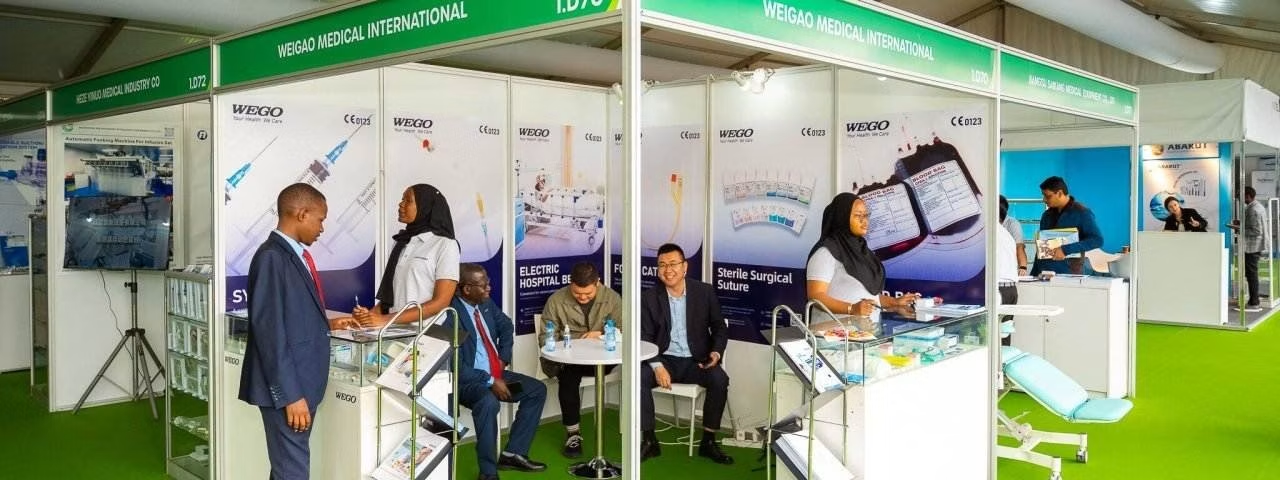
Kenya will next month become the meeting point for the companies that stock East Africa's hospitals, at a moment when almost none of that equipment is made on the continent that uses it.
The World Health Expo will run from 16 to 18 September at the Kenyatta International Convention Centre in Nairobi, Kenya's capital and the region's main business hub.
The event is being held under the patronage of Kenya's Ministry of Health, with support from the Africa Centres for Disease Control and Prevention, the African Union's public health agency, known as Africa CDC.
A show many will recognise by its old name
The expo is organised by Informa Markets, a division of the British events company Informa. Health workers across East Africa will know it as Medic East Africa, the name it carried for years before Informa folded its health exhibitions into a single global brand.
The same rebranding turned Arab Health, the long-running Dubai show, into World Health Expo Dubai earlier this year.
The exhibition covers medical devices, diagnostic equipment, digital health systems and laboratory supplies. A separate laboratory event runs alongside it, with sessions on laboratory management, the detection of infections, and molecular diagnostics, meaning tests that identify a disease by looking at genetic material rather than by growing a sample in a dish.
The organisers have described the event as a platform to showcase health innovations, attract investment, and establish Kenya as a regional medical hub.
They have also linked it to Kenya's push for Universal Health Coverage, the policy goal of making sure people can get the care they need without being ruined by the cost.
The gap the exhibition sits inside
What gives the event weight is the state of supply on the continent hosting it.
Africa CDC has reported that Africa imports 99 percent of its vaccines and between 70 and 90 percent of its medicines and medical devices.
The agency has separately put the figure for health products overall at more than 90 percent imported. In diagnostics, the picture is starker still.
An analysis by PATH, a global health non-profit organisation, found the continent exports one dollar's worth of diagnostics for every 93 dollars it brings in.
Those numbers describe an ordinary day in an African hospital.
Create a free account
Join Joseph Mmwa Media Group and be the first to know the world's biggest health and medical stories as they happen
The machine that reads a blood sample, the test strip used in a clinic, and the reagent that makes the test work are all likely to have arrived from somewhere else.
That was manageable until it was not. During the COVID-19 pandemic, countries that manufacture medical supplies restricted exports to protect their own populations, and African health systems waited at the back of the line.
A target with a date attached
African governments have since put a number on the ambition. Africa CDC and the African Union have set a goal of producing at least 60 percent of the vaccines, diagnostics and medicines used on the continent within Africa by 2040.
Heads of state reaffirmed that target in a presidential declaration published in February this year.
Two mechanisms sit behind it. One is the Platform for Harmonized African Health Products Manufacturing, which coordinates manufacturing efforts across member states and was expanded in 2024 from an earlier body focused only on vaccines.
The other is the African Pooled Procurement Mechanism, which combines the buying power of several countries so that African manufacturers have a predictable customer before they build a factory.
The distance still to travel is considerable. Vaccine production in South Africa, Morocco, Tunisia, Egypt and Senegal has covered roughly 1 percent of the continent's total vaccine demand, according to research published on Africa CDC's work with member states.
Kenya has a manufacturer of its own
Kenya is not starting from nothing here.
Revital Healthcare EPZ, a Kenyan medical device manufacturer, became the first African company to receive World Health Organization prequalification for an auto-disable syringe, a syringe designed so it cannot be reused and spread infection.
Africa CDC reported in 2024 that the company was producing more than 50 different medical devices and exporting to over 30 countries.
That is one company on a continent of 54 states, which is the point rather than the counterargument. Local manufacturers exist, and the question the sector keeps returning to is whether they can reach the scale and the regulatory approvals that let hospitals buy from them routinely.
What a trade floor can and cannot change
An exhibition does not build a factory. What it does is put buyers, regulators, distributors and manufacturers in one room, and equipment contracts often begin in exactly that setting.Holding the event in Nairobi rather than Dubai or Johannesburg means Kenyan and regional buyers can attend without the cost of international travel, and it gives African suppliers a floor on which to be seen by the people who write purchase orders.
Whether that shifts anything measurable is a separate question, and one the expo itself will not answer. Trade shows are commercial events, and most exhibitors at a show of this kind are foreign suppliers selling into an African market rather than African producers selling out of it.
Registration has opened and the exhibitor list is being published on the official event website, which will offer the first concrete indication of how much of the floor African manufacturers occupy.

Joseph Mmwa is a health and medical journalist covering breaking health news, medical research, vaccines, infectious diseases, and public health developments around the world.