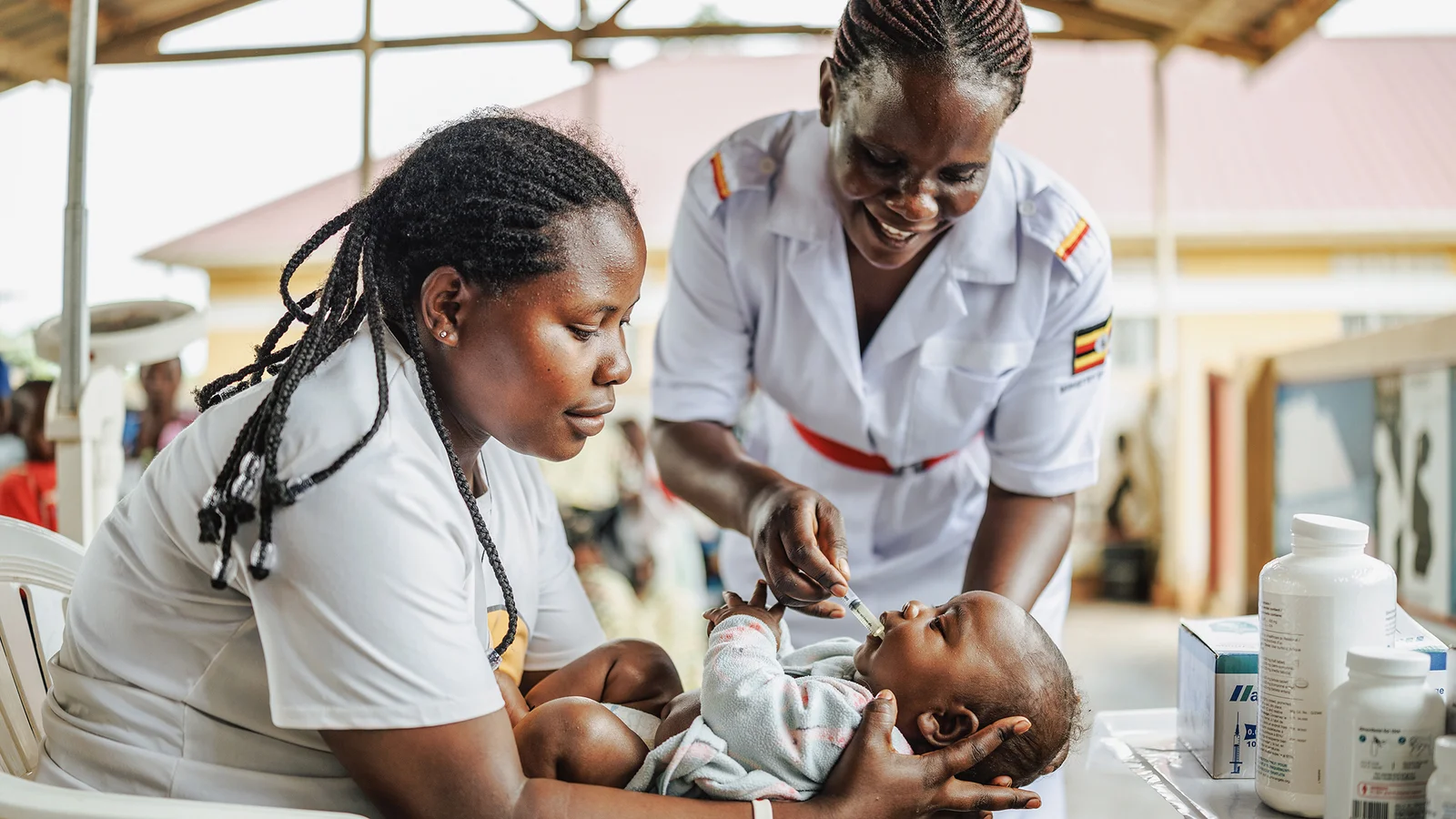
Gavi, the Vaccine Alliance, has approved a further US$189 million to support vaccine making in Africa, most of it to buy vaccines made on the continent.
For years the alliance has spent its money buying vaccines for children in poorer countries, and about 80 percent of its support goes to African countries, its 2025 annual report said.
That model reached millions of children.
It also left the continent exposed to delays and supply shocks that began far from any African clinic.
What the change involves, and what it already shows, says a lot about where the continent's vaccine industry stands.
Nineteen suppliers and an African plan
In its 2025 Annual Progress Report, published on 7 October 2026, Gavi closed the books on its 2021 to 2025 strategy.
The report counted 19 manufacturers supplying vaccines that the World Health Organization (WHO) has prequalified, meaning checked for quality, for Gavi programmes.
That is up from 5 in 2001.
Nearly half of the 19 are based in low- and middle-income countries, though the report did not say how many are African.
The report followed a year of aid cuts that left Gavi short of its 2026 to 2030 funding target, yet 73 million children were reached with routine vaccines in 2025, the most in any single year.
It also records the first steps of the change.
By the end of 2025, there were 18 expressions of interest in support from AVMA, the African Vaccine Manufacturing Accelerator, and 13 technology transfers were advancing across Africa-based manufacturers.
A technology transfer is a deal in which a company that already knows how to make a vaccine teaches an African partner to make it.
How the buying worked
Gavi's vaccines were bought through tenders, which are competitive bids, run by UNICEF, the United Nations children's agency.
The governments receiving the vaccines paid a share themselves, known as co-financing, and the report called their record US$301 million in 2025 the highest yet.
Gavi said in a 2022 paper that its rules for choosing vaccines were strict on price and did not systematically allow higher prices for the sake of supply security.
Very little of Africa's vaccine supply is made on the continent.
The Africa Centres for Disease Control and Prevention (Africa CDC), the African Union's public health agency, said in April 2021 that Africa made about 12 million of the roughly 1.3 billion doses it used each year, around 1 percent, The EastAfrican reported.
A 2025 paper in the journal Vaccine, co-written by Africa CDC officials, still put the imported share at 99 percent.
When one factory's exports paused
The weakness showed in April 2021.
The Serum Institute of India said up to 90 million doses meant for COVAX would be delayed through April while India dealt with a surge in infections, Al Jazeera reported on 1 April 2021.
COVAX was the global scheme, co-led by Gavi, to share COVID-19 vaccines with poorer countries.
John Nkengasong, then director of Africa CDC, told a press briefing in Addis Ababa that day that a lasting delay would be "catastrophic" for the continent's vaccination schedule. .
By 20 May 2021, Al Jazeera reported, several African countries had used every AstraZeneca dose they received, so people who had a first shot were waiting on a second that did not arrive.
Money that follows results
Gavi's Board approved AVMA in December 2023 and it launched in June 2024.
It pays after results. A manufacturer receives a one-time payment of US$10 million to US$25 million, depending on the vaccine, once WHO prequalifies it, the quality check that lets UN agencies buy it.
It then earns a top-up of 30 to 50 US cents on every dose delivered after winning a UNICEF tender, depending on the vaccine, according to Gavi.
The Board's ceiling is US$1 billion over ten years, and Gavi's reform tracker says the Board has ordered a review of the payment levels by December 2026.
On 2 July 2026, the Board approved the extra US$189 million beyond that ceiling, Gavi said.
Of this, US$139 million will buy African-made vaccines, with up to 70 million doses from start-up manufacturers proposed in May, to be bought through tenders once the vaccines reach the market.
The other US$50 million will go to Africa CDC, the African Medicines Agency and WHO.
What the factories show so far
Gavi said in May that AVMA's first 18 months had helped secure thirteen technology transfer agreements, and that commercial-scale plants are being built in six African countries, Gavi CEO Dr Sania Nishtar said then.
Gavi has also said the first AVMA-supported, African-made vaccines could be deployed as early as 2027, and its reform tracker says the first AVMA payments to African manufacturers are expected at the end of 2026 or early 2027, depending on regulatory progress and tender results.
In South Africa, Biovac of Cape Town secured financing from the International Finance Corporation (IFC), the European Investment Bank and the European Commission for a plant due for completion by 2028, the IFC said on 16 April 2026.
It would first make oral cholera vaccine, with capacity for 30 to 40 million doses a year, which the IFC said would address about 40 percent of the world's cholera vaccine supply gap.
Devex reported on 15 June 2026 that eight vaccines from Biovac, Aspen Pharmacare and Institut Pasteur de Dakar are expected to pass WHO prequalification by 2030, including yellow fever, measles and cholera.
Several lenders backed Biovac, so the growth cannot be credited to AVMA alone, and the technology transfer credit is Gavi's own statement.
Two things worth keeping apart
The first is the goal. In April 2021 the African Union and Africa CDC set a target for Africa to make 60 percent of the vaccines it uses by 2040, and that target is theirs, not Gavi's.
The factories above show that capacity is being built, but they do not show that the target will be met.
The second is whether doses keep arriving when something goes wrong, which is a separate question from the target.
Gavi's annual report says recent crises exposed the risk of vaccine making being concentrated in a few places, and it describes African production as an investment in resilience.
The limits
Not everyone thinks AVMA's design suits young manufacturers. ,
Els Torreele, an independent researcher in Geneva, and Heather Sherwin, director of impact investing at ELMA Philanthropies Services in Cape Town, argued in an opinion paper in PLOS Global Public Health in April 2024, two months before AVMA launched, that payments tied to prequalification and UNICEF tenders may favour larger international producers, because only companies with risk capital can reach those milestones.
Semafor cited their paper on 2 July 2026.
Gavi has said the first payments are expected at the end of 2026 or early 2027 and the first African-made vaccines could be in use from 2027, so whether the money produces doses on the shelf is still ahead.