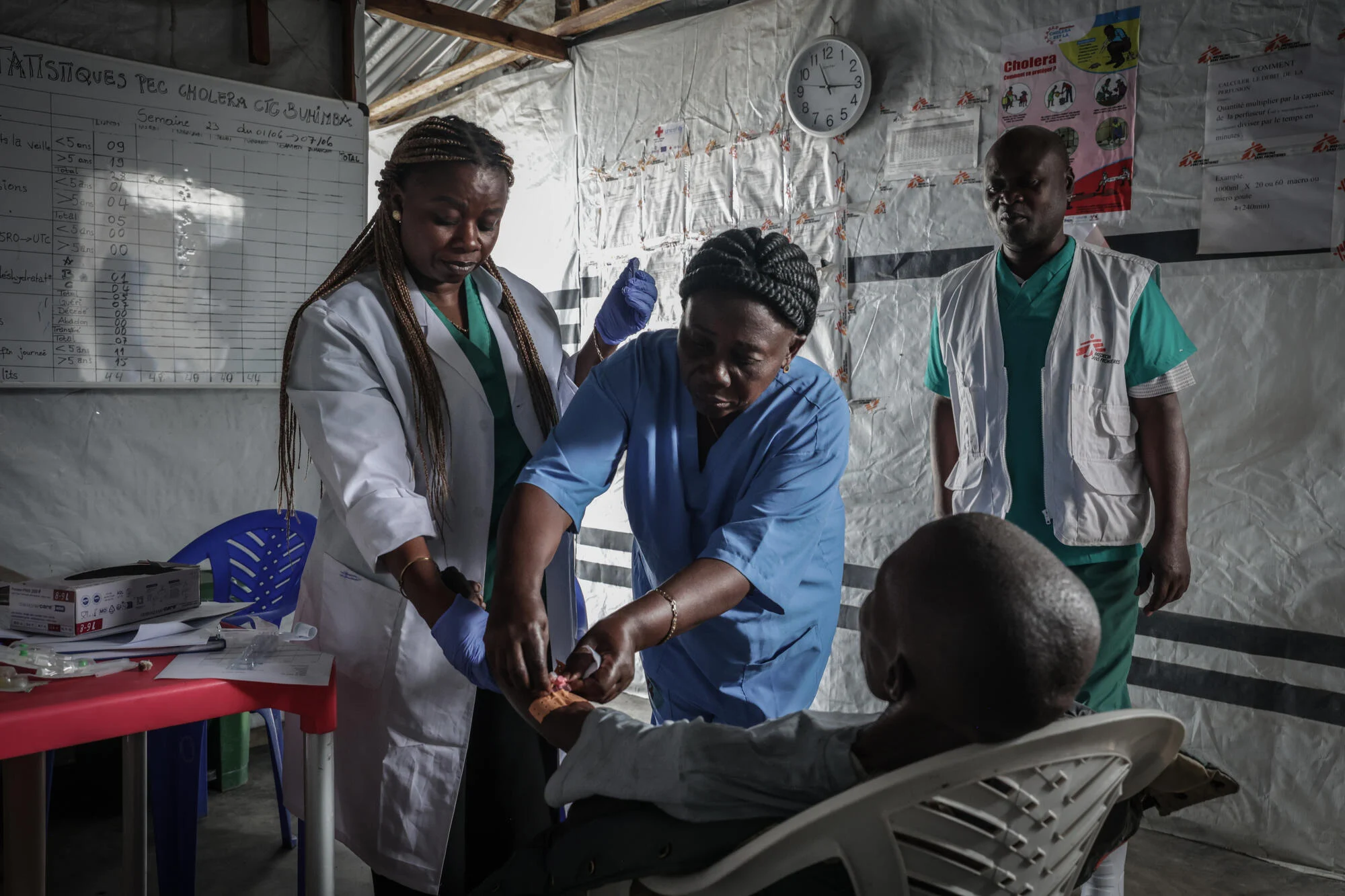
At a cholera treatment centre in Bukavu, the capital of South Kivu province in eastern Democratic Republic of Congo (DR Congo), 15 new patients came in overnight after another 14 during the day on Monday, and many arrived already in critical condition, health workers told Xinhua, China's state news agency.
The centre's head nurse, John Muka, gave the counts on Tuesday 15 September.
The centre is inside Saint Mathieu Hospital, in a country that is also facing the largest Ebola outbreak it has ever recorded.
The same hospitals, nurses and supplies are being asked to cover both.
Figures carried by Anadolu Agency, Turkey's state news agency, showed that UNICEF, the United Nations children's agency, counted more than 12,700 cholera cases in South Kivu since January, including 175 deaths.
The count came in a statement on Wednesday 30 September.
The country as a whole is also hard hit.
The United Nations Office for the Coordination of Humanitarian Affairs (OCHA) counted more than 39,400 suspected cholera cases and 1,173 deaths between January and August, Xinhua reported, and called DR Congo Africa's largest cholera hotspot.
OCHA said North Kivu and South Kivu together account for more than half of the country's new weekly cases.
Xinhua spoke to two patients' families at the Bukavu centre. Julienne Mukasa said her mother's headache and body aches turned quickly into vomiting and diarrhoea, and the family was sent on to the cholera centre.
Another patient, Atosha Mugisho, said she was so weak on arrival that she could hardly see or walk, and was doing well after treatment.
Muka described the pace on the ward in his own words.
"We cannot go 10 or 20 minutes without a new patient coming in," he told Xinhua.
Cholera in South Kivu is killing a larger share of the people it reaches.
Œil d'Afrique, a news website, drew on figures from the provincial health division and reported 11,854 cases and 160 deaths as of 19 September.
That is about 1.4 deaths for every 100 cases, up from 0.76 in 2025.
Œil d'Afrique said the rise points to care reaching patients too late.
It also reported that a division report dated 2 June showed 47 of the first 80 deaths that year happened in the community, not in a health facility.
Many patients died before reaching treatment or without ever reaching it.
Xinhua said cholera is spreading in several provinces where Ebola has also been recorded: North Kivu, South Kivu, Ituri, Tshopo and Haut-Uélé. Ebola, caused by a type of the virus called Bundibugyo, has reached seven provinces in all.
SUPPORT INDEPENDENT JOURNALISM
Help keep health journalism independent
I report and explain important health and medical stories independently, with accuracy, context and African relevance. Your support helps me continue this work.
Figures published by the European Centre for Disease Prevention and Control (ECDC), the European Union's disease agency, showed 8,116 confirmed cases and 3,924 deaths in data up to 27 September.
The World Health Organization (WHO) named Ituri, in the north-east, as the worst-hit province and North Kivu as the second.
North Kivu had 1,480 confirmed cases, and about six in every ten of those patients had died, the highest rate in the outbreak. South Kivu is the opposite case.
WHO counted only three confirmed Ebola cases there, none since 29 May, while its cholera count kept climbing.
A sick person in these provinces needs four things to go right: a clinic that is open, a bed, a trained health worker and medicine.
Médecins Sans Frontières (MSF), the international medical charity, described all four as already short on 14 August.
It said many hospitals and health centres in North and South Kivu run below capacity for lack of staff, medicines and equipment, while others have closed because of violence, after years of conflict, displacement and a sharp fall in aid money.
Beds are where the Ebola response shows most plainly.
A Reuters report by Gradel Muyisa Mumbere and Clement Bonnerot described all 29 beds full at the Kitatumba Ebola treatment centre in Butembo, a North Kivu city of about 2 million people, in the week of 25 September.
MSF's project coordinator there, Stephanie Hoffmann, told Reuters that some patients know they have Ebola but cannot find a bed.
City authorities announced two new treatment centres that week, making four.
The work does not end at the bed. Every Ebola patient has contacts, and each of those people has to be checked on.
WHO counted 32,342 people needing that follow-up as of 23 September, and its teams reached 26,980 of them in the previous 24 hours, while conflict, insecurity and displacement kept getting in the way of finding cases and tracing contacts.
Cholera care leans on the same thin supplies.
Œil d'Afrique reported that the 2 June division report warned of a risk that the supplies used to treat cholera patients could run out.
MSF also said fear of Ebola can keep people away from health facilities, which can delay care and cost lives, including from common diseases.
MSF said on 14 August that the Ebola response must not come at the expense of other health needs in North and South Kivu, naming cholera, measles and malaria.
The charity said it had treated more than 2,410 cholera patients in the facilities it supports, and that cholera was surging again in Bukavu and Shabunda in South Kivu.
Anadolu reported that health officials said cholera continues to spread because attention and resources have moved to Ebola since May.
No report cited here establishes that the Ebola response caused cholera to spread. What the reports show is one weakened health system carrying several emergencies at once.
.jpeg)