Six physician organisations in the United States have pushed back on a claim by the country's health secretary that artificial intelligence (AI), the technology behind chatbots that answer typed questions, can give patients a better informed opinion than any doctor.
Their joint statement, issued on 30 September 2026, did not name him, but it came a day after he made the remark at a health conference in Washington, the US capital.
In the statement, published by the American Academy of Family Physicians on behalf of all six, the groups said such claims "diminish physician expertise and risk undermining patients' trust".
Yet they also said AI could offer doctors new tools and insights, and the disagreement lands at a time when many patients and doctors already use chatbots in everyday care.
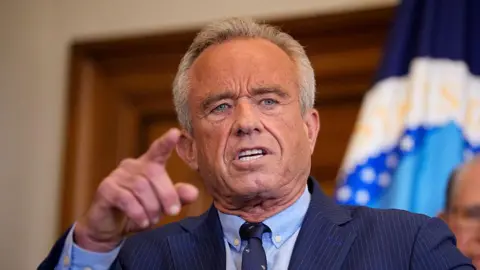
Robert F. Kennedy Jr., the United States Secretary of Health and Human Services, the country's top health official, made the remark on 29 September at the Make America Healthy Again (MAHA) Summit, in a conversation with Vice President JD Vance.
According to The New York Times, Kennedy said AI can give patients "a second opinion that is much better informed than any doctor in the country".
A second opinion is a second view on a diagnosis or treatment plan.
The Advisory Board's Daily Briefing noted that Kennedy said AI could "free us from medical tyranny".
He backed the claim by pointing to how little time doctors have, and Medical Economics wrote that he described patient records running to a thousand pages, which a doctor with six minutes for a visit cannot read in full, while AI can.
In the same roundup, the Advisory Board said Kennedy also suggested AI may give different answers from the experts on masks, social distancing and whether vaccines stop infection from spreading.
Those were his predictions of what AI may say, not findings from a study.
The Times also reported that the summit was sponsored in part by AI companies, including OpenAI, the company behind ChatGPT, and Anthropic, the company behind the Claude chatbot.
The statement was signed by the American Academy of Family Physicians, the American Academy of Pediatrics (children's doctors), the American College of Obstetricians and Gynecologists (doctors who care for women in pregnancy and childbirth), the American College of Physicians, the American College of Surgeons and the American Medical Association.
It said doctors weigh each patient's whole situation, using years of training and experience, and take responsibility for the care they give.
It also said that setting doctors against technology, or suggesting AI should replace their expertise, does not advance the work, and that patient safety and the humanity of clinical practice must guide how these tools are built and used.
The groups closed by saying they want doctors to help lead the responsible development and use of AI in medicine.
No response from Kennedy or the Department of Health and Human Services to the statement was identified in the coverage reviewed.
The International Business Times relayed Kennedy's account that Sam Altman, chief executive of OpenAI, told him it would be malpractice, meaning care below accepted professional standards, for a doctor to diagnose or prescribe without at least checking AI.
SUPPORT INDEPENDENT JOURNALISM
Help keep health journalism independent
I report and explain important health and medical stories independently, with accuracy, context and African relevance. Your support helps me continue this work.
The paper stressed that the words come from Kennedy's telling of a private conversation, and the coverage reviewed carried no confirmation from Altman.
At the same event, Felipe Millon, head of government go to market at OpenAI, described it as "medical malpractice not to get a second opinion from AI today", AI Weekly said.
According to the International Business Times, Millon also said AI should support human care rather than replace it, and that he would not advise anyone to have a major procedure simply because a chatbot recommended it.
The debate is not about a future technology.
The American Medical Association, one of the six signers, reported in March 2026 that 81 per cent of the nearly 1,700 doctors it surveyed use AI professionally, about four in five.
The most common use was summarising medical research and standards of care, followed by writing discharge instructions and care plans, and documenting visits.
Patients are using it too. eMarketer, in a report by Beth Snyder Bulik, cited a February 2026 survey by the company Tebra in which 69 per cent of American adults said they had used AI to get a second opinion after an appointment, and 45 per cent said they had done so more than once.
A March survey by the company Wolters Kluwer found that six in ten doctors and nurses said patients frequently or very frequently bring in information from AI.
The same report drew on an April survey by the company Phreesia, in which 53 per cent of consumers trusted AI to help them understand symptoms, but only 9 per cent trusted it to help manage an ongoing condition.
eMarketer read this as patients learning from AI but turning to doctors to inform decisions, and said doctors may need to spend more time explaining why their advice differs.
In August, the Journal of the American Medical Association (JAMA), a medical journal, published a Perspective, which presents an argument drawing on existing studies rather than a new clinical trial.
Becker's Hospital Review reported that its authors, University of Pennsylvania bioethicist Ezekiel Emanuel and three others, argued that AI working alone could soon deliver better care than doctors, or doctors working with AI, in five tasks, among them gathering information from patients, working out a diagnosis and managing long term illness.
Two of the four authors have financial ties to AI health companies, Becker's also noted.
They are Neal Khosla, chief executive of the AI virtual care company Curai Health, and Vinod Khosla, founder of the investment firm Khosla Ventures, which has backed Curai and other AI health startups.
The American Medical Association, which signed the statement and ran the survey above, also publishes JAMA.
The studies the authors cited tested particular tasks, and at least one used simulated cases, according to Becker's.
In another, an AI program ranked the correct diagnosis first in 60 per cent of 377 complex cases, while 20 internal medicine doctors did so in 15.9 per cent of a smaller set of 302 cases, so the two figures are not a strict side by side comparison.
Those studies tested specific tasks rather than Kennedy's broader claim that an AI second opinion is better informed than any doctor in the country, and the evidence reviewed does not establish that wider claim.
Sources:Beth Snyder Bulik, eMarketer, 2 October 2026; American Academy of Family Physicians, joint statement of six physician organisations, 30 September 2026; American Medical Association, 2026 Physician Survey on Augmented Intelligence, 12 March 2026; Giles Bruce, Becker's Hospital Review, 19 August 2026; JAMA Perspective, 17 August 2026, doi:10.1001/jama.2026.15380; The New York Times, 29 September 2026; Medical Economics, 1 October 2026; Advisory Board Daily Briefing, 30 September 2026; International Business Times UK; AI Weekly.
.jpeg)