Joseph Mmwa LogoJOSEPH MMWA

If it's health, it's here

DR Congo Hospital Shut Down for 21 Days after Ebola Kills Doctor and infects Other Staff

Kisangani first reported Ebola cases in late June, and the treatment centre where the doctor died had been inaugurated less than two weeks earlier

3 min read
54934

Photo:MSF(File)

A hospital in Kisangani, the capital of Tshopo province in the north-east of the Democratic Republic of Congo, is temporarily closed for 21 days after about ten of its workers tested positive for Ebola, and one of them, a young doctor named Victor Kingombe, has died of the disease.

Simon Bokongo, the provincial health minister for Tshopo, announced the closure of the Desmet Hospital of Kisangani on 29 September in an interview with Actualite.cd, a Congolese news site.

He said about ten staff had tested positive and that there were more than 123 contacts, a term health teams use for people who may have been exposed to an infected person.

Actualite.cd also reported that a nursery school, La Borne, was closed for 21 days after a teacher tested positive.

A doctor on the front line

Kingombe died on Thursday 24 September at the Ebola treatment centre in Kisangani, where French news site Afrik.com said he had been helping to care for infected patients.

Afrik.com also reported that he worked at Desmet Hospital and at the university clinics in Kisangani.

Fellow doctor Agnes Kalokola called him their internal medicine doctor.

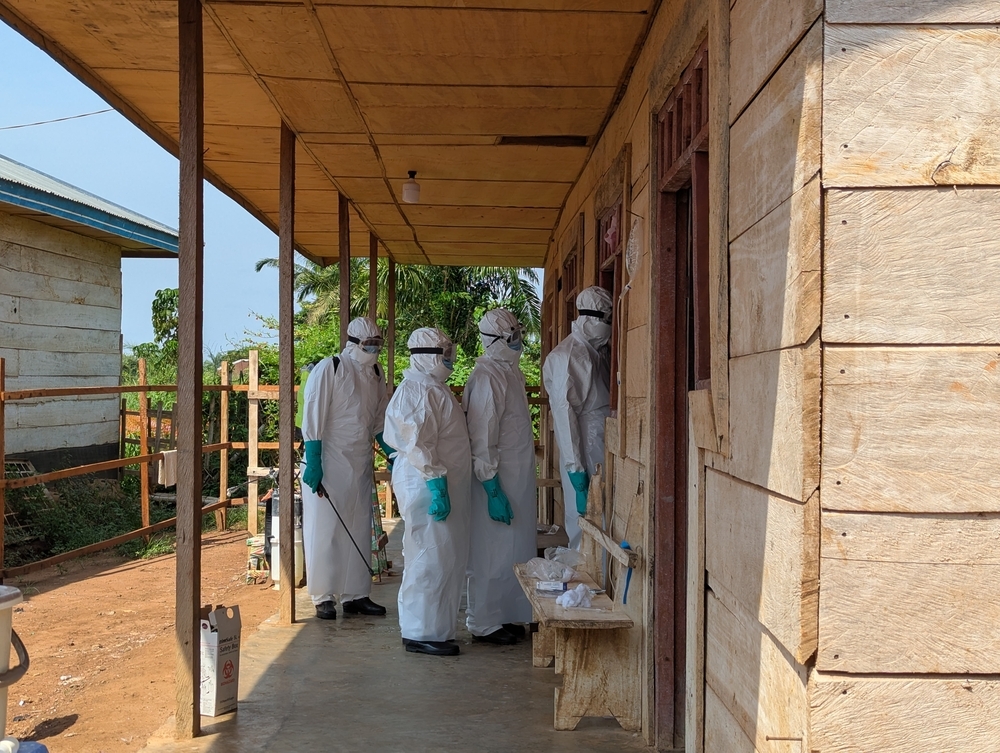
At his funeral, relatives and colleagues watched from a distance as health workers in full protective clothing carried his body to the coffin, according to a report the Associated Press published on 25 September.

Didier Lomoyo Iteku, the vice-governor of Tshopo, viewed the body through a plastic window and responded to the disbelief around the disease, saying, "This disease is real."

The report noted that many people do not believe Ebola is real.

Kisangani first reported Ebola cases in late June, and the treatment centre where Kingombe died had been inaugurated less than two weeks earlier, the report said.

Tshopo borders Ituri, the province in eastern Congo at the centre of the outbreak.

Actualite.cd reported, citing figures from the health minister, that Tshopo had 45 confirmed cases, including 18 deaths.

The toll on health workers

At least 50 health workers have died after catching Ebola since the outbreak was declared on 15 May, the news agency reported on 2 October.

SUPPORT INDEPENDENT JOURNALISM

Help keep health journalism independent

I report and explain important health and medical stories independently, with accuracy, context and African relevance. Your support helps me continue this work.

In August, Julien Harneis, the United Nations Ebola coordinator in Bunia, the capital of Ituri, said about 160 medical staff had been infected and 43 had died.

The World Health Organization said on 23 September that Congo is running short of health workers to staff its treatment centres, according to the Associated Press.

Anne Ancia, the WHO's representative in Congo, said one treatment centre needs about 300 health professionals.

In Bunia, some health workers protested over unpaid wages this week, with some saying they had not been paid for August and September, and front-line staff have gone on strike several times.

The numbers and the response

Congo's Health Ministry said on Thursday 1 October that 4,018 people had died among 8,300 cases, so nearly half of the people counted have died.

The World Health Organization described the outbreak on 10 September as the largest Ebola outbreak ever recorded in Congo.

The outbreak is caused by a type of Ebola virus called Bundibugyo.

The WHO said in September that no approved vaccine or specific treatment exists for it, though a trial of possible treatments began in July.

Health workers in Kisangani began receiving a vaccine made for a different type of Ebola in August, and the WHO says it should be used against this one only within a research study, because it is not yet known whether it works.

There are signs of progress.

Marie Roseline Belizaire, the WHO's regional emergency director for Africa, said cases fell 26 percent in Ituri between 31 August and 20 September.

She warned that the outbreak is still not under control and that cases continue to rise in other provinces.

Comments

Be the first to comment.

Related Stories

Newsletter

The MMWA Briefing

Stay ahead of the health news shaping Kenya, Africa and the world. Get the week's most important developments, research and public-health stories — explained clearly and delivered to your inbox.