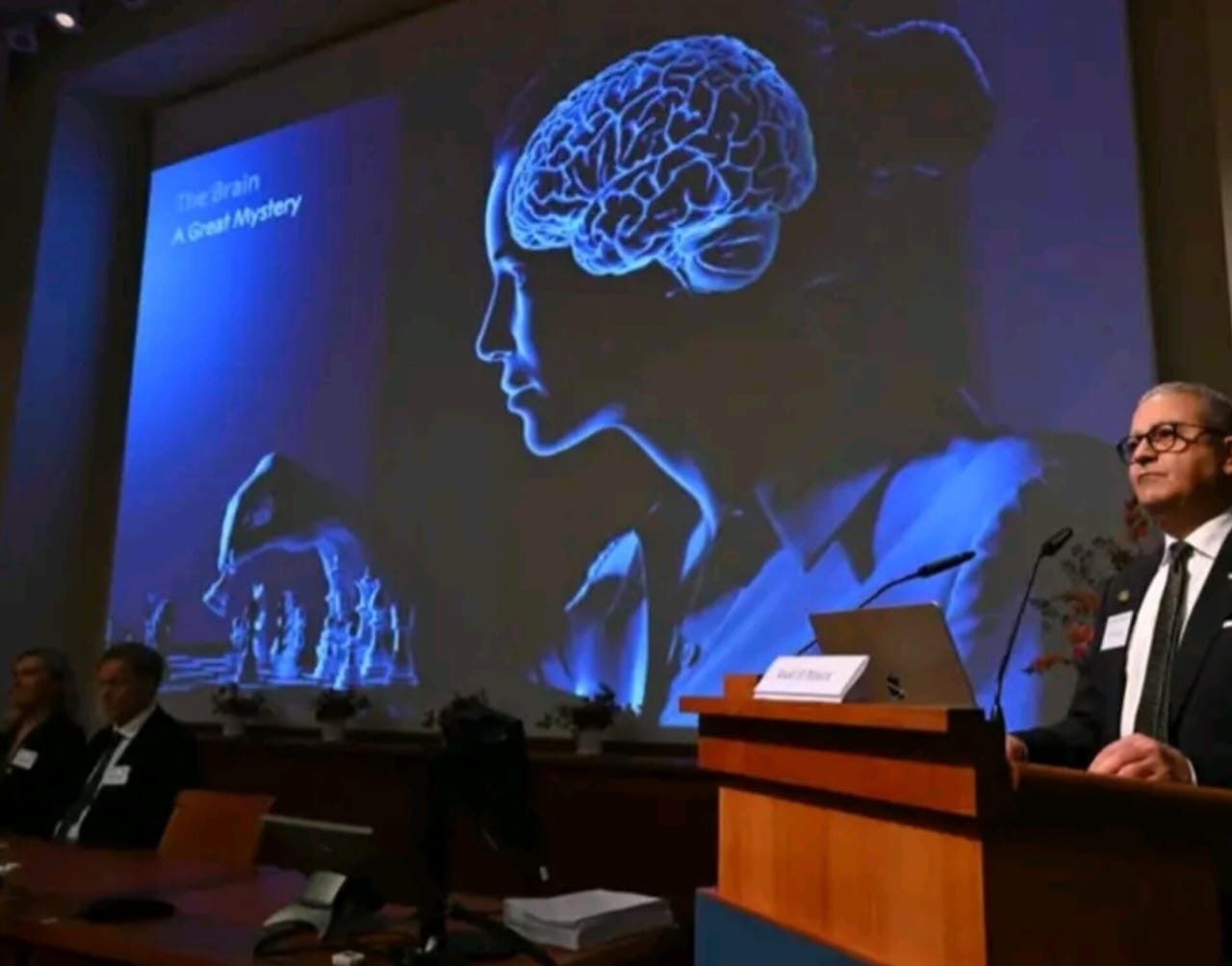
Understanding how the brain forms memories, feelings and behaviours has long been a dream for researchers.
Karl Deisseroth, Peter Hegemann and Georg Nagel have been awarded the 2026 Nobel Prize in Physiology or Medicine for discoveries that led to optogenetics, a method that makes it possible to switch the activity of individual nerve cells on or off with light in a living brain.
The method is now used in laboratories around the world to investigate how the brain works.
Optogenetics has given researchers a way to identify which nerve cells in complex neural circuits are involved in different brain functions.
Using the method, scientists have identified neural circuits involved in pain, social behaviour, thirst, food consumption, reward and attention.
Researchers have also identified nerve cells involved in functions ranging from controlling the circadian rhythm to triggering fever when the immune system is activated.
The technique works by combining light-sensitive proteins with targeted nerve cells. When light is directed at those cells, the proteins can open or close channels in their membranes, changing the cells' electrical activity.
This allows researchers to control selected cells with very precise timing and observe what happens.
The work traces back to light-sensitive proteins found in microorganisms. Hegemann and Nagel helped establish how channelrhodopsins, proteins found in the single-celled alga Chlamydomonas reinhardtii, respond to light.
Deisseroth and his collaborators later helped turn that discovery into a tool for controlling neurons.
In 2005, Deisseroth and colleagues introduced a channelrhodopsin gene into cultured rat nerve cells.
SUPPORT INDEPENDENT JOURNALISM
Help keep health journalism independent
I report and explain important health and medical stories independently, with accuracy, context and African relevance. Your support helps me continue this work.
The modified cells could then be activated by light, allowing researchers to control their firing on a millisecond timescale.
The approach was subsequently extended to living animals, allowing researchers to manipulate selected nerve cells in the brains of living mice and observe how specific neural circuits influence behaviour.
Optogenetics can also be used to study the nervous system and cell functions outside the brain.
Deisseroth has shown in experimental research that manipulating heart activity can influence anxiety-related behaviour.
Other researchers have identified specific cells in the gut involved in the preference for sugar over artificial sweeteners.
The method has also helped researchers investigate neural mechanisms involved in psychiatric and neurological disorders, including depression, anxiety, schizophrenia, Alzheimer's disease and Parkinson's disease.
The hope is that knowledge generated through optogenetics will eventually contribute to new medical treatments. Researchers are also exploring applications such as attempts to restore sight.
For now, however, optogenetics remains primarily a research tool rather than a routine treatment for patients.
The 2026 Nobel Prize in Physiology or Medicine recognises discoveries that turned a light-sensitive protein from a single-celled organism into an extraordinarily precise way of studying nerve cells.
By allowing scientists to control selected cells and observe the consequences, optogenetics has opened a powerful new window into one of humanity's greatest scientific mysteries: how the brain works.
.jpeg)