Joseph Mmwa LogoJOSEPH MMWA

If it's health, it's here

South Africa Opens New Facility to Make More of Its Own Medicine Ingredients

According to the CSIR, about 98% of the active ingredients used to make medicines in South Africa are imported

5 min readAfricaSouth Africa
WhatsApp Image 2026 10 11 at 08.58.54

Photo:X/South African Government

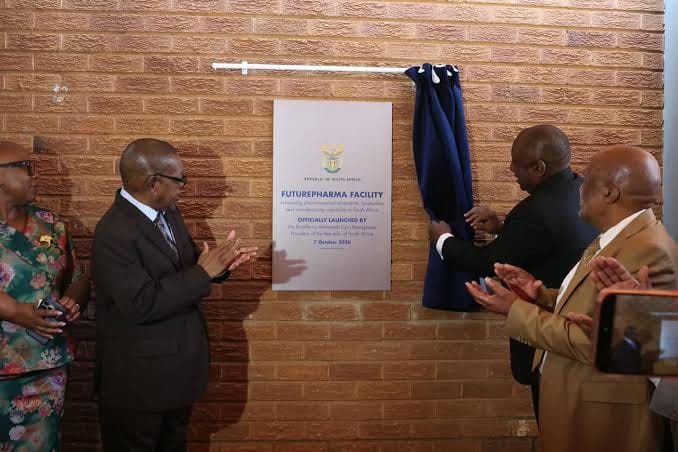
South Africa has opened a new facility in Pretoria, the seat of its government, where researchers and small companies can learn to make the main ingredients of medicines, a job the country almost entirely leaves to other nations today.

The facility is called FuturePHARMA, and it is meant to help the country depend less on imports and cope better when medicines run short.

It was set up by the Council for Scientific and Industrial Research, or CSIR, a South African government research organisation whose scientists work on health, energy, food, water, transport and other fields.

President Cyril Ramaphosa launched the facility on Wednesday 7 October 2026 at the CSIR's campus in Pretoria.

The CSIR said about 98% of the active ingredients used to make medicines in South Africa are imported, at a cost of around 15 billion rand a year, Business Day, a South African business newspaper, reported.

An active ingredient is the part of a medicine that does the treating.

Because the CSIR runs the facility, it is also the body describing the problem the facility is meant to fix, and a separate paper by a trade department economist, described below, gives the same figures.

A number that is easy to misread

The 98% describes the ingredients, not the finished medicines.

Dr Senelisiwe Ntsele, a senior economist at the Department of Trade, Industry and Competition, the government department that deals with trade and industry, wrote in an undated opinion piece, in a personal capacity, that more than 60% of the medicines sold in South Africa are formulated locally, meaning mixed and finished into tablets or syrups here.

She wrote that about 98% of the active ingredients used in that work are imported, at about 15 billion rand a year.

Local companies therefore make many medicines, but buy the part that does the treating from abroad.

For HIV and TB medicines, Spotlight, a South African health news outlet, reported in December 2024 that those ingredients usually come from India or China.

A shared workshop, not a factory

Ramaphosa said FuturePHARMA is not meant to work as a conventional commercial medicine factory, according to SAnews, the government news agency.

Its value lies in shared equipment and expertise that would be too costly for one researcher, university or young company to build alone.

Dr Rachel Chikwamba, the CSIR's group executive for advanced chemistry and life sciences, said the facility is open to researchers in universities, in other research councils and in industry, so they can take products from an idea to the clinic and beyond.

Entrepreneurs can test whether an idea works and produce first runs for market testing, SAnews added.

Business Day explained that the facility will also help researchers work out how to make batches to the standard needed for testing in patients.

It works a little like a shared test kitchen, where a baker with a good recipe can try it at a larger size before investing in a bakery.

Chemistry on one side, biology on the other

The government news agency described two major areas of work.

The first covers medicines made from small chemical building blocks, such as painkillers and medicines that reduce inflammation, using methods that include flow chemistry, where chemicals move through equipment in a steady stream instead of being mixed in separate batches.


SUPPORT INDEPENDENT JOURNALISM

Help keep health journalism independent

I report and explain important health and medical stories independently, with accuracy, context and African relevance. Your support helps me continue this work.

Guests at the launch saw demonstrations that included products made at a small test scale.

The CSIR said its team is already working on scaling up ingredients for pain relief and breast cancer treatment.

The second area will focus on medicines made from proteins, including vaccines, using plants, yeast or cells grown in a laboratory.

eNCA, a South African news channel, had Ramaphosa hailing the facility as "a game changer" as he spoke about getting plants to produce a vaccine.

About 150 million rand has been invested so far, according to Tsepo Tsekoa, the CSIR's chief researcher for biopharmaceuticals, as quoted by Business Day.

The CSIR said the facility has received support from National Treasury, the government's finance department, through the Department of Science, Technology and Innovation, the government's science department, along with other funders.

Why shortages are part of the story

The launch comes while patients in South Africa are sometimes unable to get medicines because of disruptions in global supply chains, SAnews noted.

Ramaphosa said the COVID-19 pandemic showed the risk of relying on other countries for health products.

Chikwamba described FuturePHARMA as a "sandbox", a place where the country can practise making products and test the supply systems needed in an emergency.

She said the country's response to the next health emergency will be faster, and "We will not be waiting in line" for products from other countries.

The facility could be quickly reconfigured to make products for testing in a health crisis, Business Day reported.

The country's medicines regulator, the South African Health Products Regulatory Authority, or SAHPRA, will have a role too.

Its chief executive, Dr Boitumelo Semete-Makokotlela, said that under a 2025 policy the regulator offers shorter evaluation times and lower fees for locally made health products, while keeping quality and safety standards, as reported by SAnews.

Ramaphosa also said South Africa's plans reach beyond its borders, with room for work with African researchers and companies, according to the agency's account of his speech.

What has not changed yet

The first phase was about building the ability to take research through product development and into testing in people, SAnews reported.

A second phase will focus on scaling up, which the CSIR described as developing and making products on contract, at a larger scale than now.

The CSIR said the last hurdle before products can move to testing in people is a formal qualification of the facility by SAHPRA.

Neither the CSIR nor SAnews gave a date for the second phase, or said when any medicine made with these ingredients could reach patients.

How much FuturePHARMA will cut the country's reliance on imported ingredients, put by the CSIR at about 98% today, remains to be seen as its work moves towards larger scale production.

Sources:CGTN Africa; SAnews, 7 October 2026; Business Day, 7 October 2026; CSIR, 7 October 2026; eNCA, 8 October 2026; Ntsele S, Department of Trade, Industry and Competition opinion piece on the local active ingredient industry; Spotlight, 4 December 2024

Comments

Be the first to comment.

Related Stories

Newsletter

The MMWA Briefing

Stay ahead of the health news shaping Kenya, Africa and the world. Get the week's most important developments, research and public-health stories — explained clearly and delivered to your inbox.