Joseph Mmwa LogoJOSEPH MMWA

If it's health, it's here

West Nile Virus Death Toll Rises to Ten in the Netherlands

Officials expect the outbreak to have passed its peak, following a decline in new infections in recent weeks, although this has not been confirmed

4 min readEuropeNetherlands
WhatsApp Image 2026 10 09 at 13.05.12 (1)

Ten people infected with West Nile virus have died in the Netherlands this year, one more than a week earlier, while the number of new infections fell to three in the latest week.

RIVM, the Dutch national public health institute, said on 8 October that 59 people have now been confirmed infected, up from 56, in a country that had reported no human cases since 2020.

RIVM also said it expects the outbreak is now past its peak, because the number of new infections has gone down in recent weeks.

Three new patients, the fewest in a weekly update so far

RIVM's weekly update counted 3 new patients since 1 October. RIVM said all three caught the virus from the bite of an infected mosquito, and that the number of new infections was lower than in the weeks before.

The total of people who have died rose from nine to ten, and RIVM's update does not say whether the tenth death is among the three new patients.

The weekly counts RIVM has published show 9, 10, 16, 12 and now 3 new patients.

The 16 reported on 24 September was the biggest weekly jump so far.

RIVM said it expects the outbreak is past its peak because new infections have decreased in recent weeks, and described this as an expectation, not a certainty.

Where the cases are

Most of the infected people are in South Holland, the western province that includes Rotterdam and The Hague, with 34 of the 59 cases.

Utrecht has 13, North Holland 5, North Brabant 4, Gelderland 2 and Overijssel 1, according to RIVM.

Why 59 is not the whole picture

RIVM said most people were diagnosed after being admitted to hospital with symptoms. So the count leans toward people who had clear symptoms.

The World Health Organization (WHO) says around 80 in every 100 people infected with the virus have no symptoms at all.

About 20 in every 100 develop West Nile fever, with fever, headache, tiredness and body aches.

WHO estimates that about one in 150 infected people develop the severe form, which attacks the brain and nervous system and can cause confusion, convulsions and paralysis.

People over 50 and some people with weakened immune systems face the highest risk of becoming severely ill, WHO said.

For that reason, ten deaths among 59 people cannot be read as the share of infected people who die.

The figures do not show how many people were infected, had mild illness or none, and were never tested.

A death after a blood transfusion

SUPPORT INDEPENDENT JOURNALISM

Help keep health journalism independent

I report and explain important health and medical stories independently, with accuracy, context and African relevance. Your support helps me continue this work.

RIVM reported on 17 September that one patient caught the virus through a blood transfusion, after receiving blood from a donor in whom the virus was later detected.

The patient was ill and died, and RIVM said it is unclear what caused the death.

It is one of the ten deaths.

Separately, RIVM reported in August that the virus had been found in a blood donor in Utrecht province during a study among blood donors by Sanquin Research.

WHO says a very small share of human infections around the world have come through transfusions, organ transplants and breast milk, while most come from mosquito bites.

Birds, horses and mosquitoes

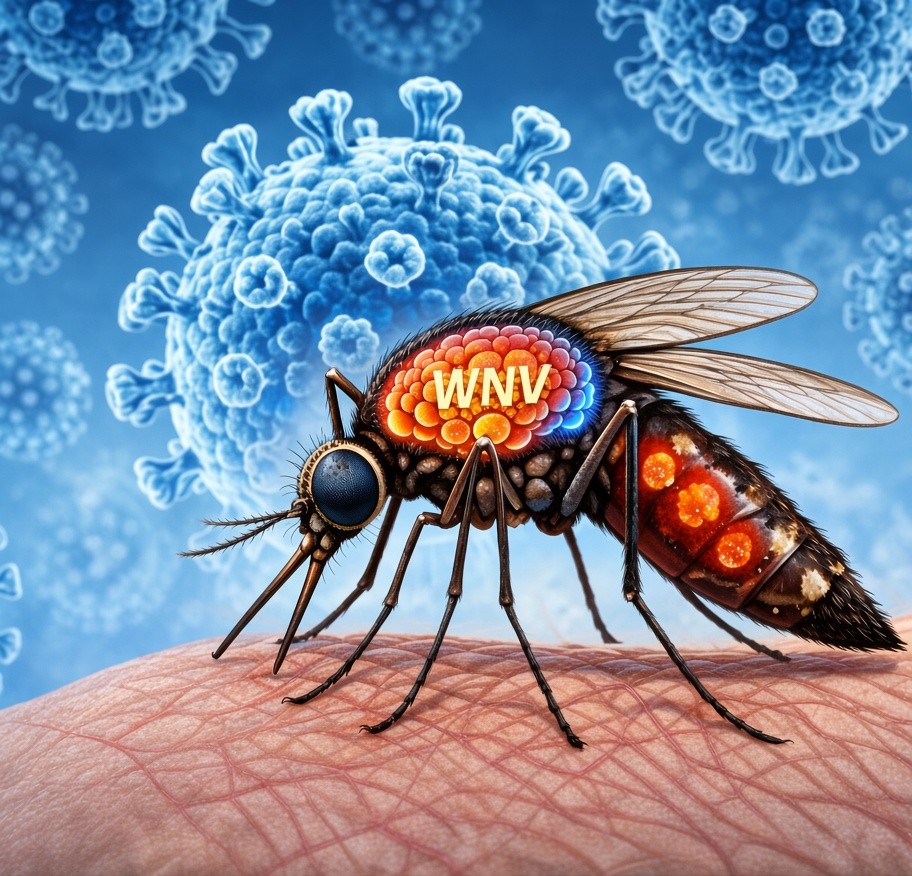
RIVM follows the virus in animals as well, because birds are its natural hosts and mosquitoes pick it up from them.

By 7 October, 210 birds and 163 horses had tested positive this year, along with 20 mosquito pools, which are batches of mosquitoes tested together.

Sixteen of those 20 pools were reported in the latest week, up from four a week earlier. RIVM's table for all of 2025 shows 7 birds, 3 horses, 3 mosquito pools and no people.

RIVM has said an infected horse cannot pass the virus on to people or other animals, and that the virus spreads through infected mosquitoes.

WHO also describes horses, like people, as dead ends for the virus.

What came before

The last time West Nile virus was found in people in the Netherlands was in 2020. Eurosurveillance, a European disease-monitoring journal, reported six people with locally caught infection that year, the first in the country.

This year's count of 59 is more than nine times that.

A hot summer across Europe

Reuters reported that the WHO has said warmer temperatures are giving mosquitoes more time and territory to spread the virus across Europe, which has had a record series of heatwaves this year, and that cases have also climbed in Greece and Italy.

RIVM's weekly updates do not say why the virus spread in the Netherlands this year.

How the virus got its name

WHO says West Nile virus was first isolated from a woman in the West Nile district of Uganda in 1937, and that it is found in Africa, Europe, the Middle East, North America and West Asia.

RIVM updates its figures every Thursday morning. The totals above are those published on 8 October.

View sources

Comments

Be the first to comment.

Related Stories

Newsletter

The MMWA Briefing

Stay ahead of the health news shaping Kenya, Africa and the world. Get the week's most important developments, research and public-health stories — explained clearly and delivered to your inbox.