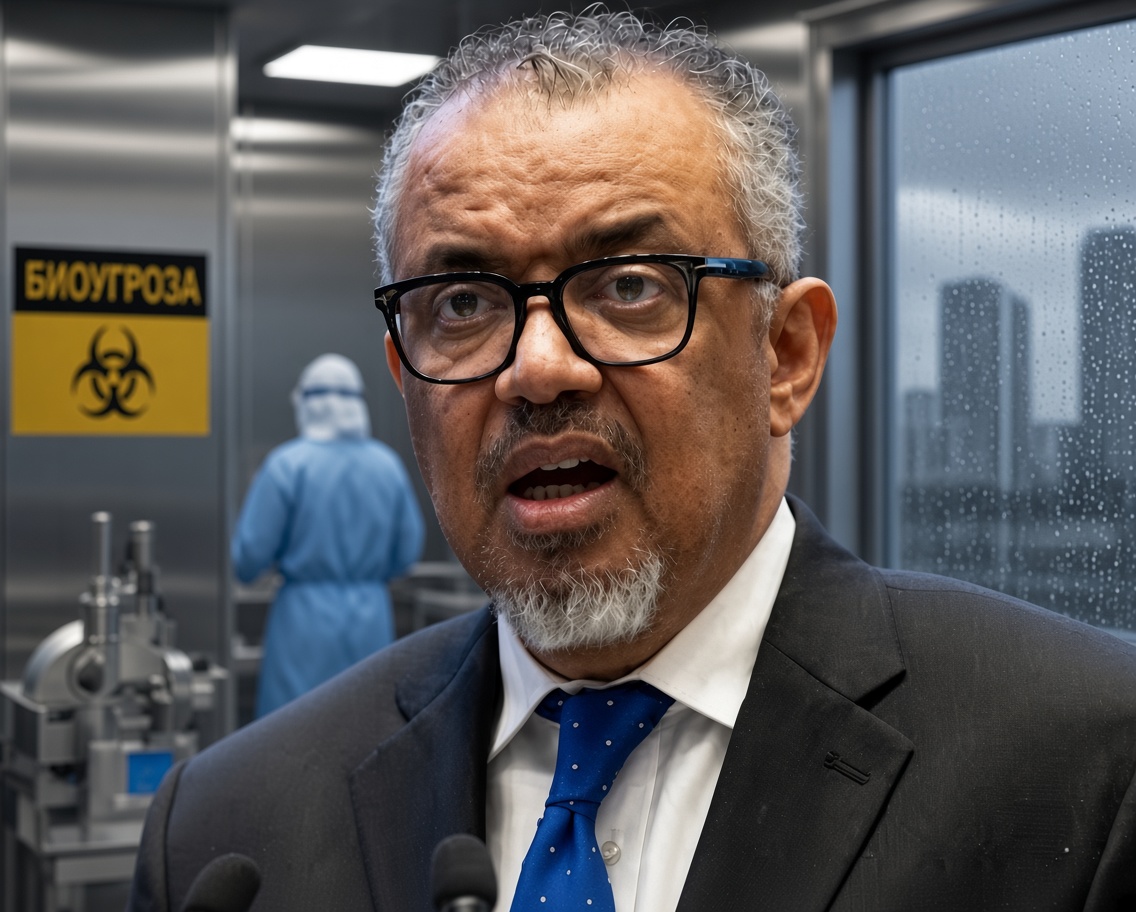
The World Health Organization (WHO) is seeking answers from Russia after a laboratory worker died of severe pneumonia amid reports that pneumonic plague was behind her death.
In a statement published on the social media platform X on 6 October 2026, WHO chief Tedros Adhanom Ghebreyesus said Russian health authorities had told the agency that no case of plague had recently been registered in Irkutsk oblast, a region in Siberia.
WHO has not confirmed plague as the cause of death.
The worker, from the Irkutsk Antiplague Research Institute, died on 2 October 2026 after being taken to hospital with severe pneumonia, a serious lung infection.
Early media reports suggested pneumonic plague, a form of the disease that infects the lungs, after an alleged accidental exposure in the laboratory.
NBC News said no cause of death had been officially confirmed.
Tedros said WHO had asked Russia to verify the reports under the International Health Regulations, the rules countries have agreed to follow when reporting health threats to the world.
Healthbeat, a US health news outlet, wrote that WHO first put its questions to Russian officials on Saturday 3 October.
They covered the laboratory tests under way, the reason for tracing contacts, and the health of the people who had met the worker.
Russia replied on Tuesday 6 October.
According to the statement, an investigation had been carried out and control measures put in place.
People who had been in contact with the worker were placed under medical observation and tested.
No high-threat pathogens, meaning dangerous disease-causing germs, were found among those contacts, and monitoring of all of them has been completed.
A WHO spokesperson told Healthbeat that Russian officials described her illness before she died as seeming like a typical acute respiratory viral infection.
The spokesperson added that Russia reported no high-threat germ in the worker or her contacts.
WHO said it has stayed in contact with the Russian authorities and offered technical support.
It has also asked for more information on three points: what caused the severe pneumonia, which germ led to the public health measures, and media reports of a second employee with pneumonia of undetermined cause.
The statement does not say who that second employee is or whether the reports are accurate. Tedros wrote that "timely, complete and transparent information sharing" is essential to clear up conflicting reports and judge the risks accurately.
The same WHO spokesperson said the agency was still waiting to hear back on what caused the pneumonia.
Reports of a possible plague death emerged publicly on 2 October. Meduza, an independent Russian news outlet, wrote that a hospital in Shelekhov, a town in Irkutsk oblast, had closed its inpatient department over a suspected highly dangerous infection.
Its report said Alexey Tsydenov, leader of Buryatia, a region next to Irkutsk, first wrote that the woman died of plague.
He then edited his post to say she may have died of plague.
Al Jazeera put the number of people reported to be under medical observation at nearly 200.
Healthbeat noted that Anna Popova, head of Rospotrebnadzor, Russia's consumer and health watchdog, flew to Irkutsk on Friday to meet regional health officials.
SUPPORT INDEPENDENT JOURNALISM
Help keep health journalism independent
I report and explain important health and medical stories independently, with accuracy, context and African relevance. Your support helps me continue this work.
On Sunday 4 October, Rospotrebnadzor said the employee had pneumonia of unknown cause, according to Al Jazeera, which cited Russia's official TASS news agency.
Healthbeat added that the watchdog called the health situation in the region stable. Radio Free Europe/Radio Liberty (RFE/RL) carried the watchdog's further statement that no accidents involving disease-causing microorganisms had been recorded at the institute.
Details published by Healthbeat, which credited the Russian news agency Interfax, show the watchdog found only two cases of COVID-19 and two of rhinovirus, a common cold virus, among the contacts tested.
The accident account came from People of Baikal, an independent Siberian news outlet. RFE/RL pointed out that Russian authorities have not publicly confirmed it.
Institute officials did not respond to Healthbeat's questions about her work.
NBC News drew on the institute's website, which says it was founded in 1934 to combat plague. It now also covers diseases such as cholera and anthrax.
The institute lies in a region where plague bacteria occur naturally, as Healthbeat pointed out.
WHO's plague fact sheet, updated on 29 September 2026, describes pneumonic plague as especially contagious, able to spread from person to person through respiratory particles.
It says the illness can be fatal within 18 to 24 hours of its start if left untreated, while common antibiotics can cure it if given early.
For close contacts of pneumonic plague patients, the fact sheet lists identification and monitoring, plus a seven-day course of preventive antibiotics.
That is why a suspected case can lead to close contacts being identified and monitored. In Irkutsk, media reports put the number placed under observation at nearly 200.
Russia has told WHO that monitoring of all identified contacts is finished and that none showed a dangerous germ.
RFE/RL quoted a US State Department spokesperson as saying the department was monitoring the situation closely with the Centers for Disease Control and Prevention (CDC), America's national public health agency.
US Secretary of State Marco Rubio said on 5 October, RFE/RL reported, that he saw no cause for alarm but wanted the situation watched closely.
By Tuesday, Healthbeat said, Rubio was telling reporters in Iceland that it was up to Russia to share more information with the world.
Speaking to Healthbeat, Andrew Weber, a former US assistant defense secretary for chemical and biological defense programs, said he was not yet reassured by official Russian statements.
He said the response could be extreme caution or could mean more cases, and he did not say more cases had occurred.
Ashish Jha, CEO of the biological intelligence company BioRadar, wrote on X that assuming there was only one case would be unwise, in a post Healthbeat cited.
Neither RFE/RL nor Healthbeat found public evidence linking the death to a weapons programme.
The cause of the pneumonia has not been named.
Whether a laboratory accident occurred remains unconfirmed: local reports allege one, while Russian authorities say no accident involving disease-causing microorganisms was recorded. The report of a second employee is unexplained.
For now, the cause of the illness remains unconfirmed.
Sources:WHO, statement by Tedros Adhanom Ghebreyesus on X, 6 October 2026; WHO, Plague fact sheet, 29 September 2026; Alison Young, Healthbeat, 6 October 2026; Alex Raufoglu and RFE/RL's Siberia.Realities, RFE/RL, 5 October 2026; Meduza, 2 October 2026; Al Jazeera, 5 October 2026; NBC News, 5 and 6 October 2026
.jpeg)