.jpeg&w=3840&q=75)
For 41 Million People Living With HIV Treatment May Soon Mean Freedom From Taking Daily Pills
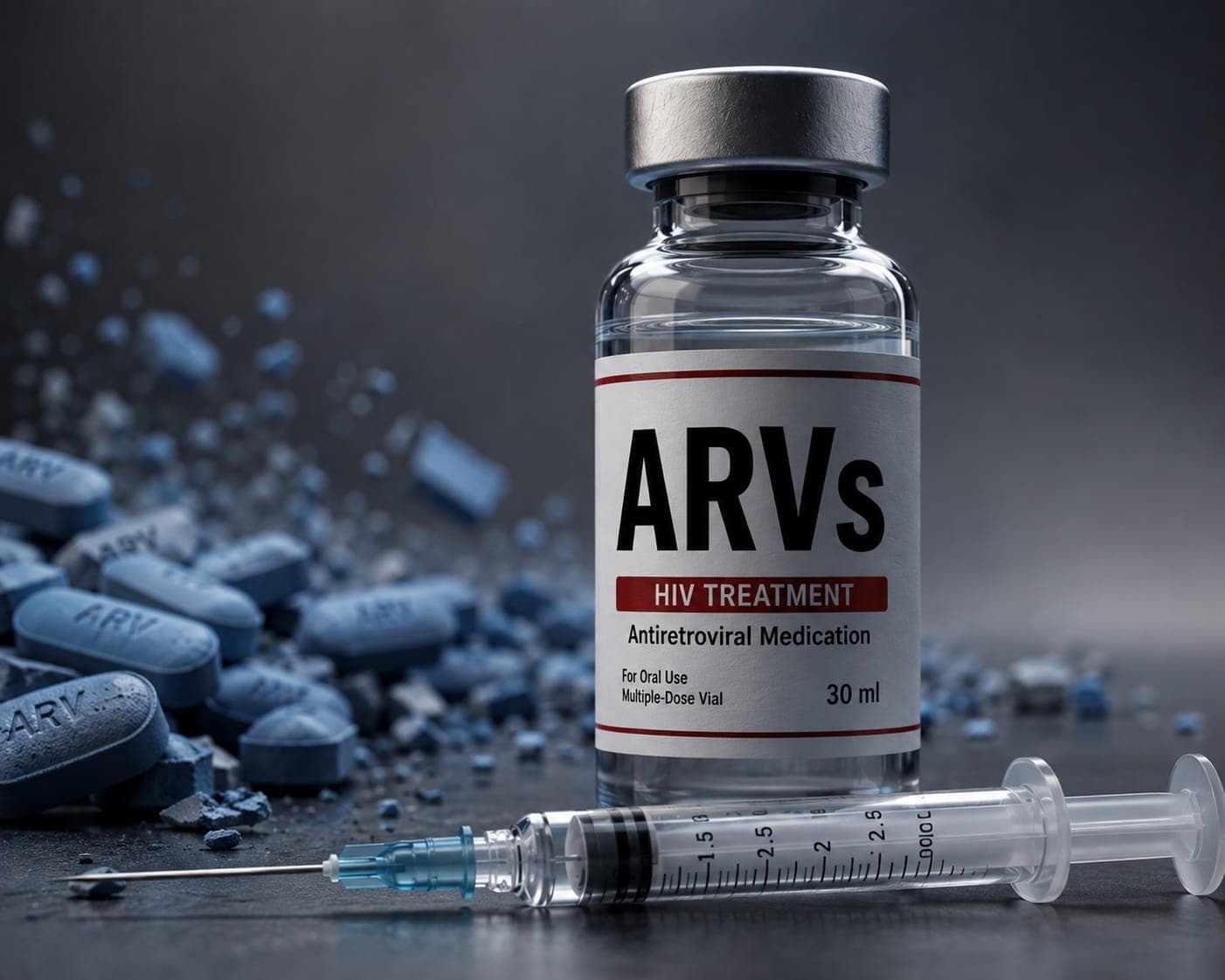
Around the world, 41 million people are living with HIV, and about 32 million were accessing antiretroviral treatment in 2025.
For most, that has meant the same routine for years: taking a tablet every day, usually as lifelong treatment.
Missing doses can let the virus rebound and raise the risk of treatment failure — so the pill becomes something to plan around, every day, without fail.
That routine is starting to loosen for some.
Scientists have developed long-acting HIV injections that can replace daily oral treatment for people whose HIV is already fully suppressed.
Cabotegravir and rilpivirine, given as a shot every two months, are already doing this for some patients who qualify.
Some of the strongest proof comes from Africa itself.
In the CARES trial, 512 adults in Kenya, Uganda and South Africa — all already virally suppressed, with no history of treatment failure — either stayed on daily tablets or switched to the injection.
After 96 weeks, 97% in both groups still had the virus fully suppressed, according to results published in Nature Medicine.
Then came an even more striking result — this time in teenagers.
In a trial of 476 adolescents across Kenya, South Africa, Uganda and Zimbabwe, only 2 of 235 on the injection saw the virus return.
Among those on daily pills, 15 of 241 did. In that trial, the injection didn't just match the pill.
It was statistically superior.
Asked about their experience, 94% said the injections were much easier to take than daily medication.
That matters.
For a teenager dealing with stigma, privacy concerns or the daily burden of medication, treatment is not only about whether a drug works.
Create a free account
Join Joseph Mmwa and be the first to know the world's biggest health and medical stories as they happen
It is also about whether someone can realistically live with it.
The injections are not free of downside, though.
In trials, injection-site pain was common — though usually mild and short-lived.
The shift is not only in treatment.
Lenacapavir, a separate twice-yearly injection, is now being used to prevent HIV in people who do not have the virus.
By late July 2026, close to 66,000 people across nine African countries had started on it.
In South Africa alone, more than 55,000 people had started it by early September, with women — particularly pregnant and breastfeeding women — making up the majority of recipients.
But this is not for everyone, not yet.
Cabotegravir and rilpivirine are not for everyone either.
They are currently recommended as an alternative only for people whose HIV is already fully suppressed and who don't also have hepatitis B.
Daily tablets remain the backbone of treatment for the roughly 32 million people receiving it worldwide.
Still, something has shifted.
For a growing number of people living with HIV, treatment may no longer have to mean a pill they remember every day.
It may instead mean a clinic visit every two months, with far less medication to remember in between.
Sources: Nature Medicine (CARES trial); 26th International AIDS Conference, Rio de Janeiro (LATA trial, lenacapavir rollout data); UNAIDS 2026 Fact Sheet; WHO; South African Department of Health

Related Stories

Anthrax Outbreak In Zambia Kills 60 Wild Animals, Sickens 12 People
7 in 10 People on South Africa's New HIV Prevention Injection Lenacapavir Are Women
Egypt's Minapharm Advances African-Led Ebola Vaccine as DRC Outbreak Spreads

More Than 55,000 South Africans Start New HIV Prevention Injection Lenacapavir In Just Over 3 Months
Comments
Be the first to comment.