.jpeg&w=3840&q=75)
More Than 55,000 South Africans Start New HIV Prevention Injection Lenacapavir In Just Over 3 Months
New figures from South Africa's Department of Health show more than 55,000 people have started lenacapavir, a twice yearly injection for HIV prevention, in the three months since its national rollout began
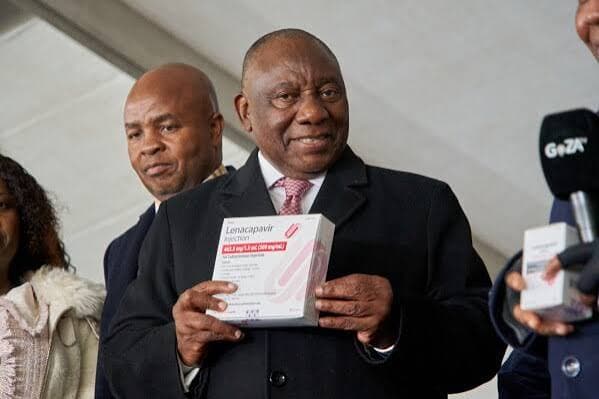
South African President Cyril Ramaphosa holds a box of lenacapavir during his country’s official launch of the drug on June,5 ,2026(AP Photo/Kayleen Morgan)
More than 55,123 people in South Africa had been initiated on lenacapavir, a twice yearly injection for HIV prevention, by 7 September 2026, the country's Department of Health said in a statement issued on 8 September.
The figure covers just over three months since the jab was first made available nationally, part of a WHO backed push that has already reached several other African countries.
A six monthly injection instead of a daily pill
Lenacapavir is for people who do not have HIV but are at risk of getting it.
The regimen starts with an injection paired with a short course of tablets over the first two days, and after that, a person needs only one follow up injection every six months to stay covered, instead of taking a pill every day.
President Cyril Ramaphosa and Health Minister Dr Aaron Motsoaledi launched the programme nationally on 5 June 2026. Since then it has expanded to 360 public health facilities across 24 districts in six of South Africa's nine provinces, the department said.
Gauteng leads the rollout so far
Gauteng, the province home to Johannesburg and the capital Pretoria, has recorded the highest number of initiations, more than 26,357.
KwaZulu-Natal follows with 11,941, then North West with 4,479, Western Cape with 4,446, Mpumalanga with 4,294 and Eastern Cape with 3,606.
Women account for 71% of everyone initiated so far, and the department said most of them are pregnant or breastfeeding.
Building on an already large prevention programme
South Africa was not starting from zero. A national rollout plan for lenacapavir reported that 2.04 million people had already started the daily prevention pill since 2016, one of the largest such programmes anywhere.
Despite that scale, UNAIDS estimated that 170,000 people acquired HIV in South Africa in 2024, within a range of 150,000 to 190,000, a gap officials hope a longer lasting option can help narrow over time.
Create a free account
Join Joseph Mmwa and be the first to know the world's biggest health and medical stories as they happen
Lenacapavir's registration followed the PURPOSE 1 and PURPOSE 2 clinical trials. In PURPOSE 1, none of the participants who received the injection acquired HIV.
In PURPOSE 2, two infections occurred among 2,179 people who received it, a rate 96% lower than the background HIV rate in that trial and 89% lower than among people taking the existing daily pill.
The results were strong enough that Dr Tedros Adhanom Ghebreyesus, Director General of the World Health Organization (WHO), called lenacapavir the most significant advance in HIV prevention since the first antiretroviral medicines were approved nearly 40 years ago.
The South African Health Products Regulatory Authority (SAHPRA) approved and registered lenacapavir on 27 October 2025, after reviewing preclinical, clinical and manufacturing data, becoming the first regulator on the continent to do so.
That followed WHO prequalification of the injectable and tablet forms on 6 October 2025, a step that made the products eligible for purchase by United Nations agencies and global health donors, and WHO prevention guidelines issued in July 2025.
Part of a wider rollout across the region
South Africa's progress sits inside a broader regional push.
Dr Tedros said in March 2026 that the WHO had supported nine countries to begin offering lenacapavir within eight months, namely Eswatini, Kenya, Lesotho, Mozambique, Nigeria, South Africa, Uganda, Zambia and Zimbabwe. Zambia and Zimbabwe used the WHO's Collaborative Registration Procedure, which let their regulators lean on WHO's own prequalification review rather than starting from scratch, completing their reviews in 12 and 18 working days.
What the numbers show, and what they do not
The Department of Health's figures describe how many people have started lenacapavir, not how many HIV infections have actually been prevented, since that will only become clear with follow up over time.
The department said it is monitoring commodity supply, service quality, client follow up and safety with provincial health departments, healthcare workers and partner organisations, and that lenacapavir is being offered as one option within a wider range of HIV prevention choices already available in public clinics.
Anyone with serious or persistent side effects after the injection is encouraged to report them to healthcare workers at their nearest facility.
Three months in, the early numbers point to strong demand, though whether the programme narrows South Africa's HIV infection rate will take longer to show.

Related Stories
7 in 10 People on South Africa's New HIV Prevention Injection Lenacapavir Are Women
Egypt's Minapharm Advances African-Led Ebola Vaccine as DRC Outbreak Spreads
Namibia inaugurates first public-sector MRI machine since independence
New TB Vaccines Could Save 7.3 Million Lives by 2050, Gavi Says
Comments
Be the first to comment.