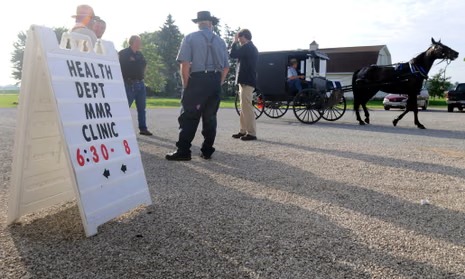
At the Central Pennsylvania Clinic in Belleville, a small town in Mifflin County, a sign is now taped to the front door.
It tells anyone with measles symptoms to stay in their car and phone ahead.
For many Amish families the clinic serves, that instruction doesn't work, since they often travel by horse drawn buggy and don't own a car or a cellphone.
For them, the sign has a backup plan: put on a mask, ring the bell, and step back from the door, MS NOW reported on September 25.
The clinic, along with nearby Lancaster County, sits at the centre of a measles outbreak spreading through Amish communities across Pennsylvania, most of whom have not been vaccinated, according to the report.
Doctors there told MS NOW they are struggling to contain the spread while bracing for flu season, which could push hospitals already stretched thin past their limit.
Measles was declared eliminated in the United States in 2000, meaning the virus no longer spread continuously within the country.
Pennsylvania's outbreak, one of the largest the country has seen since, has reversed that in one state.
The Pennsylvania Department of Health had recorded 835 cases across 39 of the state's 67 counties as of September 23, according to state figures reported by Contagion Live, a jump of 104 cases in a single week.
The state also counted 164 hospitalisations and four deaths tied to the outbreak.
Nationally, the Centers for Disease Control and Prevention had confirmed 3,471 measles cases so far this year as of the same week, MS NOW reported, with more than 300 of those patients hospitalised.
Pennsylvania's outbreak fits a pattern researchers have documented before.
In 2014, an Amish community in Ohio went through a nearly identical outbreak: over 380 cases, almost all in unvaccinated households, most linked to travelers returning from the Philippines.
Doctors who studied it, writing in the New England Journal of Medicine in 2016, found the outbreak spread fastest through communities with tight social and family networks, the same closeness that makes Amish life resilient in other ways, but that lets a virus like measles move from household to household with little to stop it once it's inside.
The comparison matters because it shows the current outbreak isn't an isolated failure.
It is what happens anywhere vaccination coverage drops below what's called the herd immunity threshold, the roughly 95% coverage level needed to keep a highly contagious virus like measles from spreading through a population.
According to CDC data, Pennsylvania is one of just a handful of states below that threshold this year, alongside South Carolina, Utah and Texas, all of which have had outbreaks of their own since 2025.
Only ten states nationwide currently sit above it.
That context helps explain something doctors on the ground in Belleville are living through directly.
Dr. Katherine Mascia, a pediatric geneticist at the Belleville clinic, told MS NOW that many of her patients don't reach her until the illness has already progressed.
"Many of our patients, by the time they present to us, they're already so sick that they require hospitalization or even ICU stays," she said, in comments reported by the outlet on September 25.
SUPPORT INDEPENDENT JOURNALISM
Help keep health journalism independent
I report and explain important health and medical stories independently, with accuracy, context and African relevance. Your support helps me continue this work.
Dr. Stanley Martin, an infectious disease specialist at Geisinger Medical Center in Danville, about 30 miles from Belleville, told MS NOW he has personally treated "well over 90 cases" of measles this year.
Complications can include pneumonia, secondary bacterial infections, and encephalitis, a swelling of the brain that can cause lasting neurological damage, according to the report.
Both doctors said the outbreak is straining a resource hospitals can't easily expand: negative pressure rooms, which pull air out of a patient's room rather than letting it circulate, keeping an airborne virus like measles from escaping into hallways and other wards.
"Our hospitals have limited rooms, limited negative pressure rooms, and when those rooms are being used by these very very sick measles patients, then that impairs our ability to care for other illnesses," Mascia told MS NOW.
Pennsylvania's Department of Health has linked four deaths to the outbreak over the past month.
The CDC initially did not include any of them in its national count.
This week, the agency updated its measles tracking page to show one measles related death nationwide, without saying where it occurred or whether it was among Pennsylvania's four, MS NOW reported.
A note on the page said the figure is "subject to change" as the CDC completes its review.
The agency did not respond to MS NOW's request for comment.
The gap between the state and federal counts has fed a public dispute between Pennsylvania Gov. Josh Shapiro and Health and Human Services Secretary Robert F. Kennedy Jr.
Shapiro has accused Kennedy of downplaying the outbreak, pointing to past comments in which Kennedy, visiting Lancaster County, described the treatment for measles as "chicken soup and vitamin A."
Kennedy has said the administration's response is working, citing comparisons to Mexico's case numbers and describing federal cooperation with state health agencies as having "brought it to an end overnight," a characterization Pennsylvania's ongoing case count does not support.
In August, President Trump signed an executive order calling for more research into, and flexibility around, childhood vaccines, and separately proposed splitting the combined measles mumps rubella shot into three individual doses.
Asked what evidence supported his description of the MMR vaccine as risky, Trump said he had heard the claim from unnamed people, and that combining the three vaccines "can be explosive," a claim MS NOW reported medical experts dispute, saying there is no established need to split the shot and no evidence the combined version is unsafe.
Health authorities, including the CDC's own published guidance prior to this dispute, have long held that two doses of the combined MMR vaccine give about 97% protection against measles.
Both Mascia and Martin told MS NOW they have leaned on colleagues and the state health department for support, rather than the federal government, through the outbreak.
For Martin, watching a disease the country had eliminated a quarter century ago return has been hard to reconcile.
"It's a real bitter pill," he told the outlet.
"For families, it changes everything for them overnight. But for the healthcare personnel, it's also very difficult to wrap your head around.
These are people that should have been living full, normal lives."
.jpeg)