.jpeg&w=3840&q=75)
African Health Leaders Meet in Nairobi to Strengthen Dementia Care for Millions
An estimated 1.9 million people are currently living with dementia across the African region, and that number is expected to climb as populations grow and people live longer according to WHO Africa
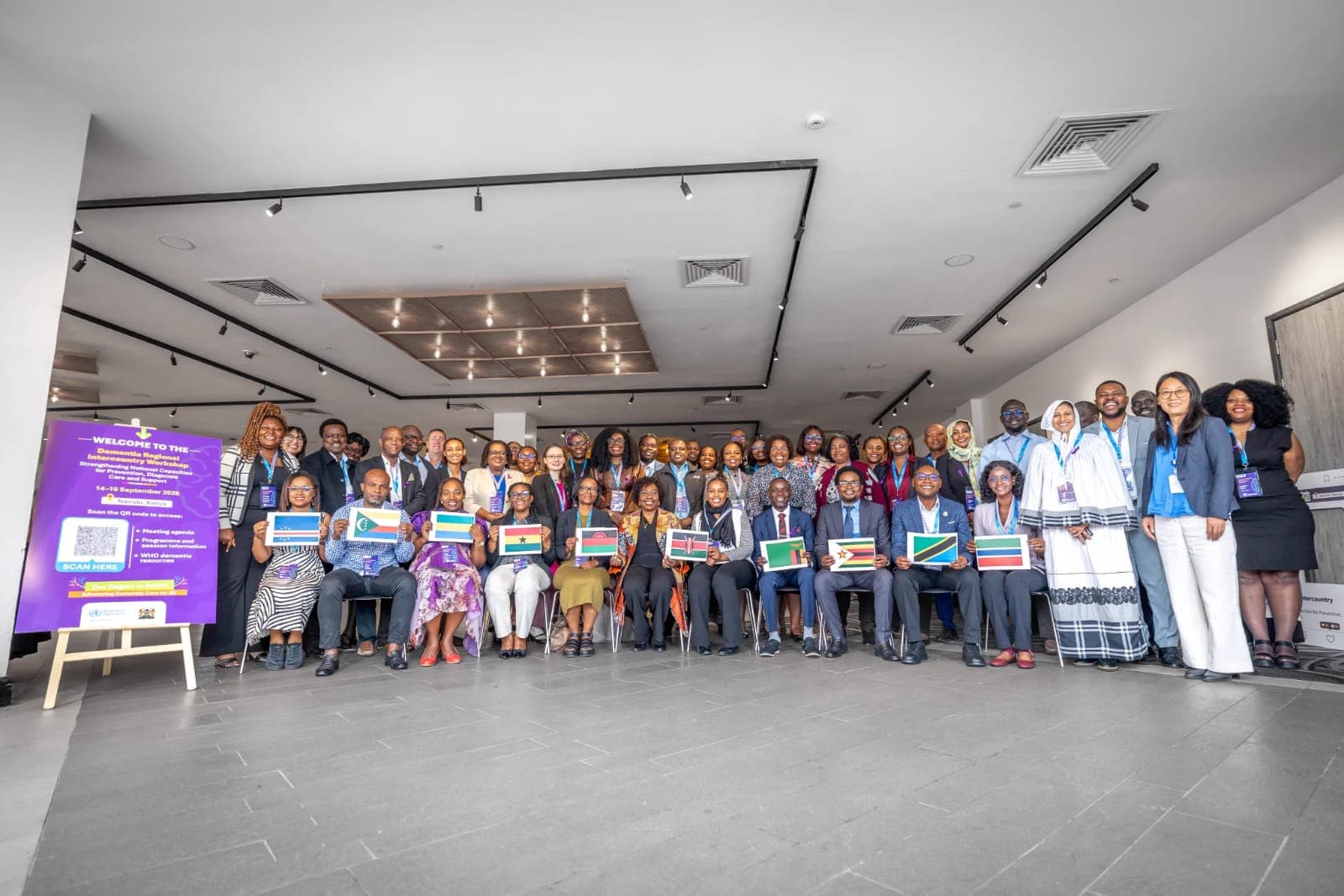
Photo;X/WHO Kenya
Health officials from ten African countries spent three days in Nairobi this week working out how their governments can catch up on one of the continent's fastest-growing but most neglected health problems: dementia.
The meeting closed on 16 September 2026, and it exposed how little formal support currently exists for people living with the condition, and for the people caring for them, mostly unpaid, mostly women.
A condition growing faster than the response to it
Dementia is a general term for a decline in memory, thinking and the ability to carry out daily tasks, usually caused by diseases like Alzheimer's that damage the brain over time.
According to the World Health Organization Regional Office for Africa (WHO AFRO), which hosted the workshop, an estimated 1.9 million people are currently living with dementia across the African region, and that number is expected to climb as populations grow and people live longer.
The financial toll is already large.
WHO AFRO put the annual economic cost of dementia in the region at roughly US$15.6 billion.
Much of that cost does not show up in hospital budgets.
Instead it lands directly on families. Unpaid caregivers, most of them women, spend an average of 12.9 hours a day caring for a relative with dementia, WHO AFRO reported, well above the global average of 7.8 hours.
Almost no country has a plan
Despite the scale of the problem, WHO AFRO said that as of 2024, not one of the region's 47 countries had a national dementia plan, whether as its own standalone policy or folded into a broader health strategy.
Only five countries had run public campaigns to raise awareness about dementia, and just seven were running any activities aimed at reducing people's risk of developing it in the first place.
Data is also thin.
WHO AFRO said only 10 countries in the region reported dementia figures to the organization as of 2024, which makes it harder for governments to plan services or track whether anything is improving.
Create a free account
Join Joseph Mmwa and be the first to know the world's biggest health and medical stories as they happen
What happened in Nairobi
The Regional Intercountry Workshop on Dementia ran from 14 to 16 September 2026 in Nairobi, Kenya's capital, bringing together health officials from Cabo Verde, Comoros, Gabon, The Gambia, Ghana, Kenya, Malawi, Tanzania, Zambia and Zimbabwe, according to WHO AFRO.
The countries are all at different stages of building a dementia response, but the workshop gave them a shared space to agree on priorities.
Those priorities included fighting stigma against people with dementia, training health workers to diagnose and treat the condition earlier, folding dementia care into everyday primary healthcare rather than treating it as a specialist issue, supporting family caregivers, and building better systems to track how many people are affected.
"Dementia is a public health priority for Africa. As the number of people affected continues to grow, countries need guidance, tools and data to act," said Dr Benido Impouma, Director of the Health Promotion, Disease Prevention and Control Cluster at WHO AFRO, describing the workshop as a step toward building the region's collective response.
The meeting did not only involve officials.
WHO AFRO said people living with dementia, family caregivers, civil society groups and academic institutions also took part, sharing experiences that shaped the priorities the workshop settled on.
Public awareness came up repeatedly as a way to chip away at the stigma many families face.
What comes next
Delegates agreed to set up a regional community of practice on dementia, a standing network meant to let countries share what is working, learn from each other, and coordinate rather than build responses in isolation, WHO AFRO said.
Countries are expected to use the priorities from the workshop, along with assessments done beforehand, to shape national roadmaps for dementia policy.
"This workshop must translate into concrete action at country level. Our priority is to ensure that dementia is recognized early, that people can access quality care and support, and that families are not left to face it alone," said Dr Catherine Wanjiku Waweru, Focal Person for the Intersectoral Global Action Plan on Epilepsy and Other Neurological Disorders at Kenya's Ministry of Health.
Whether that translates into actual national plans is now up to the individual governments.
Originally reported by WHO Africa — News Release. View original source

Related Stories

Australia to End Free COVID-19 Vaccines for Most People From October 1

WHO Approves New RSV Vaccine Vial to Protect More Babies Globally

Japan Sets Record as People Aged 100 Surpass 100,000
Fiji Declares HIV Outbreak a National Crisis as New Infections Hit Record High
Comments
Be the first to comment.