Joseph Mmwa LogoJOSEPH MMWA

If it's health, it's here

Ebola Vaccinations Reach DR Congo's Outbreak Epicentre as Cases Pass 7,500

Ebola has killed more than 3,600 people in what is already the largest outbreak ever recorded in the Democratic Republic of Congo. Vaccination has now reached the city at its centre, the same day the case count crossed 7,500

3 min readAfricaDR Congo
Ebola Vaccination Joseph Mmwa

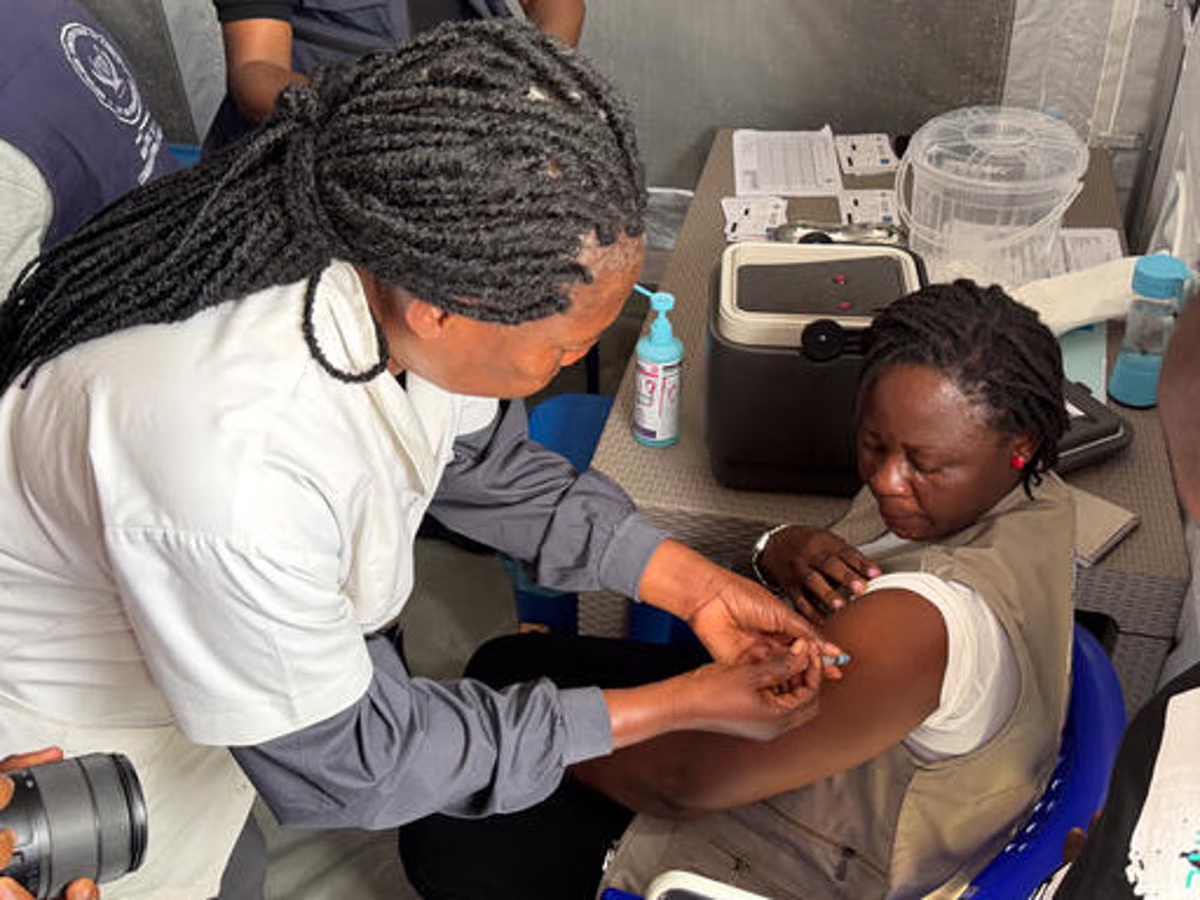
A nurse from the Congolese Ministry of Health vaccinates a woman during the launch event of the BRAVO study at the Bunia Provincial Public Health Laboratory (copyright MSF/Kristen Poels)


Ebola has killed more than 3,600 people in the Democratic Republic of Congo's outbreak, now the largest ever recorded in the country.

Vaccination reached Bunia, the city at its epicentre, the same day the national case count crossed 7,500.

The Associated Press reported that the rollout, which began on 19 September 2026, targeted the Bunia and Mongbwalu health zones in Ituri province, both among the hardest hit.

Ituri's military governor, Major-General Gaby Kasongo Mulumba, received the first dose himself to encourage the wider population to come forward.

He told the AP that frontline health workers there are "particularly exposed and deeply involved in the response."

The toll behind the milestone


Government figures released on 19 September 2026 put the national toll at 7,541 confirmed cases and 3,639 deaths.

A day later, on 20 September 2026, the European Centre for Disease Prevention and Control published a higher, harmonised count for the same period: 7,672 confirmed cases and 3,699 deaths.

The World Health Organization's most recent Disease Outbreak News, published 10 September 2026, describes the outbreak as sustained, still expanding geographically, and already the largest Ebola outbreak ever recorded in Congo — with a substantial scale-up of the response under way "to get ahead of" it.

Why vaccination alone doesn't answer the question

Ervebo, the vaccine being deployed, is licensed for Ebola virus disease, caused by Ebola virus, formerly called Zaire ebolavirus.

This outbreak is driven by a different species, Bundibugyo virus, for which no vaccine is licensed anywhere.

On 19 August 2026, WHO's Strategic Advisory Group of Experts on Immunization reviewed the available evidence and concluded it remains insufficient to support routine use of Ervebo against Bundibugyo virus disease, and that its efficacy in humans against this virus is unknown.

WHO's resulting recommendation, issued the same month, restricts Ervebo's use against Bundibugyo virus to within a research protocol.

Part of the reasoning behind trying the vaccine anyway traces to an Africa CDC briefing in late August 2026.

According to CIDRAP's account of that briefing, Placide Mbala-Kingebeni of Congo's National Institute of Biomedical Research described an anecdotal observation: some health workers vaccinated with Ervebo during a 2018 Ebola outbreak, and later infected with Bundibugyo virus in this one, appeared to develop less severe illness than unvaccinated colleagues.

SUPPORT INDEPENDENT JOURNALISM

Help keep health journalism independent

I report and explain important health and medical stories independently, with accuracy, context and African relevance. Your support helps me continue this work.

The observation was anecdotal. It did not establish that the vaccine offered protection.

WHO's own guidance sets out two ways to generate the missing evidence: a ring-vaccination randomised controlled trial, which WHO calls the most rigorous design available, or an observational vaccine-effectiveness study, used where a ring trial isn't feasible.

BRAVO, the study MSF and its research arm Epicentre launched in Bunia on 19 September 2026, is the second kind.

Run with Congo's Ministry of Health, it targets 20,000 frontline workers across Ituri and North Kivu provinces and will generate real-world evidence on Ervebo's potential effectiveness against Bundibugyo virus.

The study runs nine to twelve months in total: three months of vaccination, followed by at least six months of participant follow-up.

A separate Phase 3 trial using the ring-vaccination design WHO considers more rigorous is also planned.

The doses on the ground

On 20 August 2026, WHO and Africa CDC announced that Congo had been allocated an initial 70,000 Ervebo doses from the global vaccine stockpile: 50,000 for health and frontline workers, and 20,000 for the Phase 3 trial.

By mid-September 2026, 16,520 of those doses had reached the country, Xinhua reported, citing Africa CDC figures.

Vaccination itself began earlier, on 27 August 2026.

By 17 September 2026, Congo's government put the national total at 3,771 people vaccinated, according to figures reported by Xinhua: 3,063 in Tshopo province and 708 in Bas-Uélé.

What the vaccination expansion does and doesn't mean

Reaching Bunia brings the campaign to the province WHO identifies as the outbreak's epicentre.

It does not establish that Ervebo protects against Bundibugyo virus.

That question is what BRAVO is designed to generate evidence on, and a more definitive answer would come from the separate ring-vaccination trial WHO considers the rigorous test.

With transmission still sustained and spreading geographically, the case count that passed 7,500 on 19 September is likely to keep climbing before it slows.

Comments

Be the first to comment.

Related Stories

Newsletter

The MMWA Briefing

Stay ahead of the health news shaping Kenya, Africa and the world. Get the week's most important developments, research and public-health stories — explained clearly and delivered to your inbox.