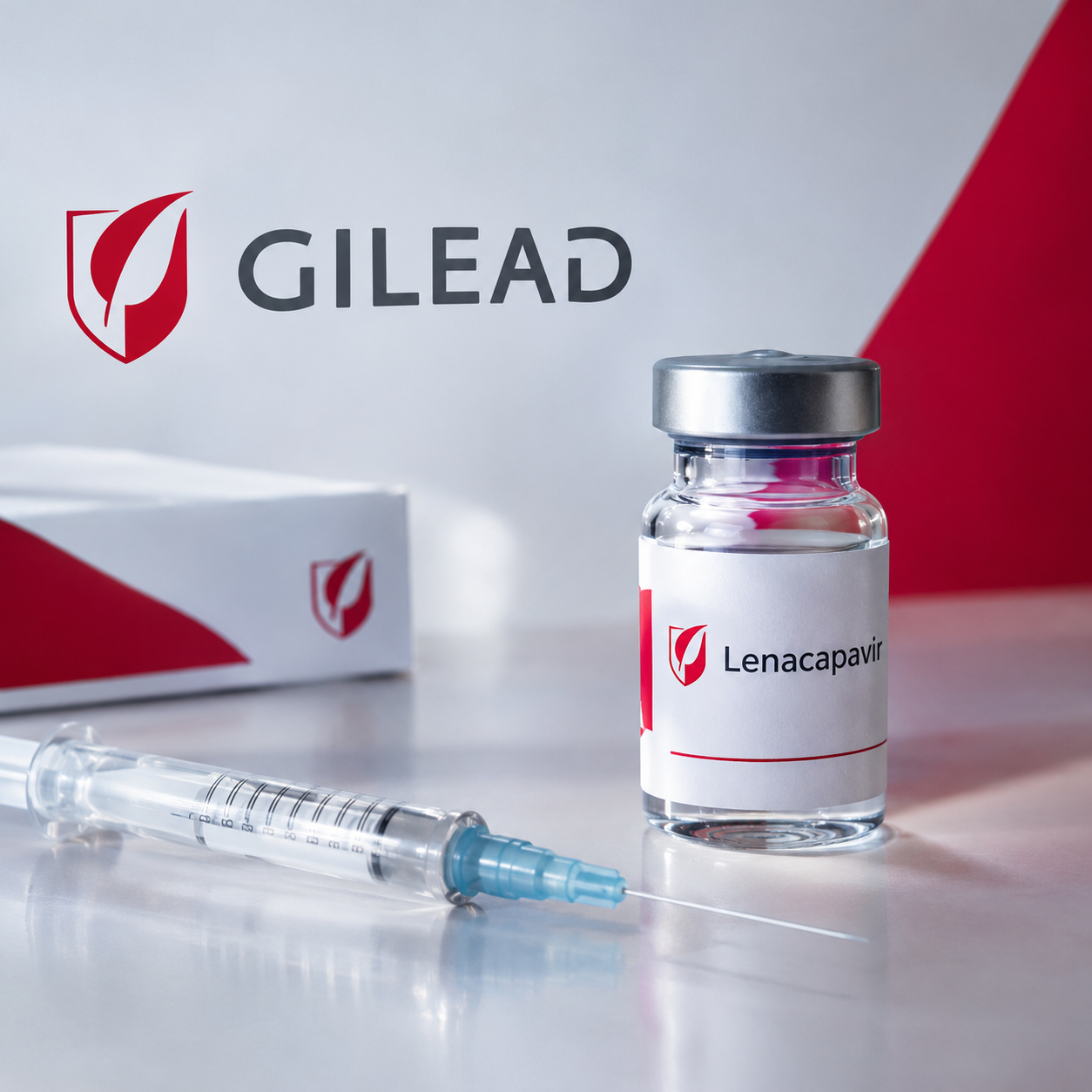
Gilead Sciences, the American drug company that makes the twice-yearly HIV prevention injection lenacapavir, said on 19 October 2026 that it would present 28 pieces of research at IDWeek 2026.
IDWeek is a large meeting of infection doctors and researchers, held in Washington, D.C., from 21 to 24 October.
Gilead's list covers HIV prevention, a new once-daily treatment tablet and an experimental herpes medicine.
Two of the 28 presentations are oral talks.
One looks at how lenacapavir, sold in the United States for HIV prevention as Yeztugo, was used in its first nine months after US approval, from June 2025 to March 2026.
Gilead described it as a study of adoption in the United States, so it says nothing about use in Kenya or elsewhere in Africa.
The second oral talk covers a study called ACCELERATE, which looks at how quickly people with HIV who have dropped out of care can restart treatment.
Other presentations look at how people get HIV prevention medicine, known as PrEP (pre-exposure prophylaxis, taken by people without HIV to lower their chance of catching it).
Gilead listed studies on Black women and on people involved with the justice system in the United States, along with the economic effect of wider access to prevention.
Bixlenvo is a once-daily tablet that combines two HIV medicines, bictegravir and lenacapavir.
It is meant for adults whose HIV is already controlled by treatment and who are switching from their current regimen.
It is not a first treatment for someone newly diagnosed.
Gilead announced on 27 August 2026 that the US Food and Drug Administration had approved it.
As of 19 October, Gilead said no regulator outside the United States had approved the combination.
The company will present new analyses from two studies, ARTISTRY-1 and ARTISTRY-2, on trial participants who also had high cholesterol, high blood pressure, diabetes or kidney problems.
These are results from people in the trials.
They do not show the tablet suits everyone with those conditions.
GS-1179 is an experimental pill being developed to suppress recurrent genital herpes.
Gilead will present early Phase 1b results on how well it worked against the virus and on its safety.
Gilead calls it investigational, and the announcement reports no approval by any regulator.
Early results do not show it works as a routine treatment.
Lenacapavir has been rolled out in nine African countries: Eswatini, Kenya, Lesotho, Mozambique, Nigeria, South Africa, Uganda, Zambia and Zimbabwe. Eswatini, a small kingdom in southern Africa, and Zambia were first.
The Global Fund, the international body that pays for HIV, TB and malaria programmes, said doses reached both countries in November 2025 and the first injections were given a month later.
The World Health Organization (WHO) recommended the injection for HIV prevention on 14 July 2025, saying it has been shown to be highly effective at reducing the risk of HIV acquisition.
Within months of those first injections, nearly 66,000 people had newly started lenacapavir across about 900 sites in the nine countries, aidsmap reported in July.
The numbers kept climbing.
The Global Fund counted 20,000 people by the end of May, 49,000 by the end of June and nearly 100,000 across the nine countries by mid-August.
Several countries show how fast it moved. South Africa launched its national programme on 5 June, and its Department of Health said 55,123 people had started by 7 September at 360 public facilities, according to APA News.
Women made up 71 percent of them.
Mozambique launched in April, and aidsmap reported nearly 10,000 people had started at 55 health facilities in three provinces.
In Eswatini, an estimated 3,000 people had started across 27 sites by May, a Ministry of Health spokesperson told SciDev.Net, as Juta MedicalBrief reported.
In Uganda, NPR reported that nearly 20,000 doses arrived in February, distribution began in April, and an estimated 980 people had started by August.
More is expected.
The Global Fund said that by the end of 2026, 24 countries worldwide are expected to receive lenacapavir with support from the Global Fund, the United States and other partners.
It also expects generic versions, made by other companies at lower cost, to enter the market by the end of 2026, with rapid uptake in 2027.
The Clinton Health Access Initiative (CHAI), a health organisation that tracks medicine supply, has estimated that about 20 million people could benefit from the injection, NPR reported.
By late August 2026, 15,800 Kenyans were due for their second lenacapavir injection as the programme entered its continuation phase, The Eastleigh Voice reported on 29 August.
Continuation doses are the follow-up injections given to people already on the medicine, to keep their protection going.
Earlier, The Star reported on 21 June that about 7,900 people had received the injection since the rollout began in February.
John Muchangi's report cited preliminary figures from the National AIDS and STIs Control Programme (NASCOP), the government programme that runs HIV prevention, and the health group LVCT Health.
Each injection protects for six months.
People who received their first dose between February and April were due their second between August and September.
NASCOP's head of HIV prevention, Dr Barbara Mambo, told DeFrontera that the stock held at the Kenya Medical Supplies Authority (KEMSA), the agency that stores and delivers public medicines, was being used so that people who started in February, March and April could complete their course.
DeFrontera, an independent health newsroom, counted 993 doses across the 15 first-phase counties on 26 August, in a report by Denis Mwangi.
It said NASCOP had paused enrolment of new clients while it waits for more supplies. DeFrontera reported that Kenya expects 136,000 more doses by the end of 2026, bought by the Global Fund and the US President's Emergency Plan for AIDS Relief (PEPFAR).
It also reported that health workers in Kilifi County were pointing people to other prevention options, including daily PrEP pills and a long-acting injection called cabotegravir.
Kenya received its first 21,000 starter doses on 17 February 2026, through the Global Fund. DeFrontera reported that US government money paid for the purchase.
The Ministry of Health announced the delivery on 20 February.
On 26 February, Health Cabinet Secretary Aden Duale launched the injection at Riruta Health Centre in Nairobi, where Samson Mutua became the first Kenyan to receive it.
Duale said that in this first phase the injection is free of charge to eligible people at selected public health facilities in priority counties.
The Standard reported that the first phase covers 15 counties with a high number of HIV cases: Mombasa, Kilifi, Machakos, Nairobi, Kajiado, Nakuru, Uasin Gishu, Kakamega, Busia, Siaya, Kisumu, Migori, Homa Bay, Kisii and Kiambu.
It quoted Dr Patrick Amoth, the Ministry's Director-General for Health, as saying a second phase would cover another 15 counties and a third the remaining 17.
Community health groups say reaching a clinic also matters.
Dennis Kinoti, clinical services lead at CFK Africa, a community health group working in Nairobi's Kibera settlement, told SciDev.Net that travel costs, lost wages, long waits and awareness of the injection affect how many Kibera residents reach a facility, as Juta MedicalBrief reported.
JosephMmwa.com contacted Gilead Sciences and NASCOP for comment on the rollout and access. Neither had responded by the time of publication.
Lenacapavir is free in Kenya. Health Cabinet Secretary Aden Duale said at the 26 February launch that, in this first phase, eligible people receive the injection free of charge at selected public health facilities in priority counties.
He asked Kenyans to report any health worker or facility that charges for it, Citizen Digital reported.
That promise covers the first phase only, and the launch statement did not say what happens after it.
Reuters reported on 24 September 2025 that the Indian companies Dr Reddy's Laboratories and Hetero planned to sell generic lenacapavir for about US$40 a year, starting in 2027.
Gilead's chief executive, Daniel O'Day, said the company supplies the injection at no profit to PEPFAR and the Global Fund, and expects large-scale generic supply from other manufacturers from 2027, according to SciDev.Net as reported by Juta MedicalBrief.
In April, Gilead and its partners widened the commitment to reach one million more people, three million in all over three years.
MSF's Tom Ellman called the extra million “a tiny fraction of what's needed” for the epidemic.