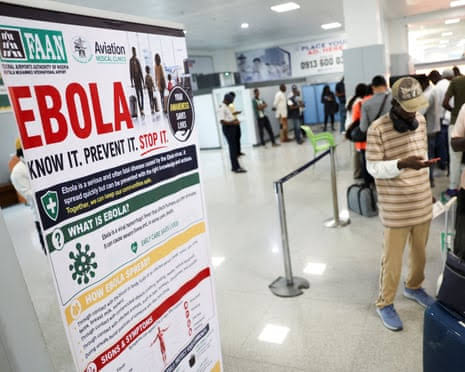
Nigeria's health minister said on 23 October 2026 that the Ebola virus found in Nigeria's first patient is closely related to the virus found in Kenya's first patient, which Reuters described as the first genetic link between the two cases.
Both patients travelled through Uganda, which says it has no confirmed active Ebola cases, and investigators have not yet found where the Nigerian woman caught the virus.
Muhammad Ali Pate, Nigeria's Coordinating Minister of Health and Social Welfare, said there is no evidence that the Kenyan patient ever travelled to Nigeria.
He added that the two viruses being related does not by itself explain how the infection reached Nigeria.
Both patients carry the Bundibugyo type of Ebola virus, the same type behind the outbreak in the Democratic Republic of the Congo (DRC).
As of 20 October, the World Health Organization (WHO) reported 9,704 confirmed cases and 4,687 deaths there.
Two patients, one route through Uganda
Kenya's first patient was a man who travelled from the DRC through Uganda to Nairobi, Kenya's capital.
WHO said he had been ill for about a month and had received care at several hospitals in the DRC.
He arrived in Nairobi on 3 October and died on 5 October, and Kenya reported his laboratory-confirmed case on 6 October.
Kenya's Ministry of Health said on 23 October that the country now has nine confirmed cases, including two deaths.
The latest death was a 65-year-old woman, a close relative of the first patient, who developed symptoms while in quarantine.
WHO said the other cases include four family members and four health and care workers, and that all were already in quarantine when their symptoms began.
The ministry said all nine cases belong to one cluster, with no evidence of spread in the wider community, and that 135 contacts have been traced and quarantined.
Seven patients are being treated at two isolation facilities.
Nigeria's patient is a woman who lives in Abuja, the capital, and is 42 years old, according to Premium Times.
WHO said her symptoms began on 7 October, four days after she arrived in Nigeria, and that she sought care in Abuja on 11 October.
Tests confirmed Ebola on 20 October.
She is in isolation receiving medical care, and 44 people who may have been exposed to her are being monitored.
Reuters reported that Pavel Ursu, the WHO representative in Nigeria, said the information the agency received indicated she was in Uganda from 16 September until she returned to Abuja on 3 October.
Did the two patients cross paths at Entebbe airport?
The Africa Centres for Disease Control and Prevention (Africa CDC) said both patients passed through Entebbe International Airport, Uganda's main international airport, on 3 October, according to Premium Times' report of its briefing.
Wessam Mankoula, the agency's head of emergency preparedness and response, said officials are checking whether the two shared equipment or had any other contact.
He called this one of several possibilities and stressed that no connection has been established.
Being at the same airport on the same day is not the same as meeting, and officials have not confirmed whether the two used the same facilities or had any contact at all.
Genetic testing compares the code inside the virus taken from different patients, and viruses from the same chain of infection tend to look very alike.
Nigeria's health ministry said further analysis could give more clues about where the virus came from and how it spread.