.jpeg&w=3840&q=75)
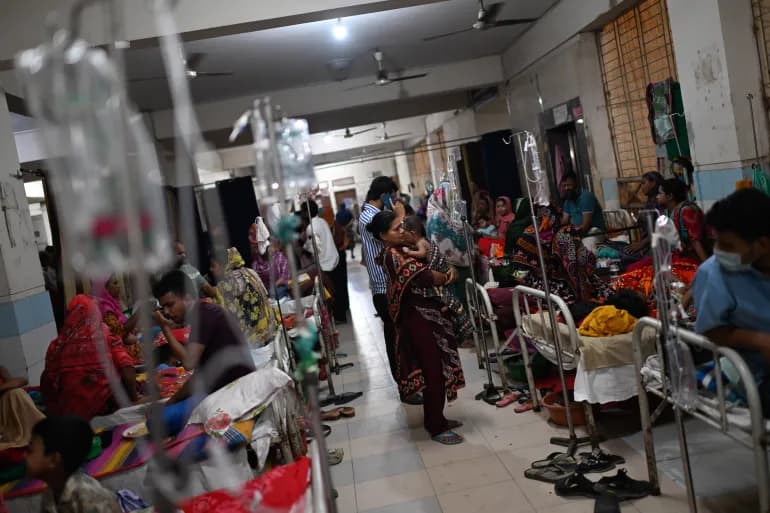
Patients receive treatment during a measles outbreak at an overcrowded hospital in Dhaka, Bangladesh, on September 8, 2026. Image credit: Mahmud Hossain Opu/AP Photo
Bangladesh's Directorate General of Health Services (DGHS) had recorded 1,009 measles deaths by September 9, 100 of them laboratory-confirmed and the remaining 909 classified as suspected, in an outbreak that began in mid-March, Al Jazeera reported on September 14, citing the health authority's own figures.
The country's dengue toll separately reached 149 deaths and more than 51,800 hospitalisations this year by September 14, according to DGHS data reported by the Indo-Asian News Service (IANS), with 52 of those dengue deaths recorded in just the first 13 days of September alone. Both diseases are now filling the same hospitals in Dhaka at once.
The scale becomes clearer with one comparison drawn in Al Jazeera's reporting: last year, Bangladesh recorded 132 measles cases in total, and not a single death.
Two diseases, one set of hospital beds
Dengue is spread by mosquitoes and has nothing medically to do with measles, which spreads through the air between people.
But the two outbreaks are now colliding inside the same wards. DGHS reported a record 1,571 new dengue hospital admissions in a single day on September 8, alongside a record nine dengue deaths in that same 24-hour period, the worst day either count had seen all year, The Business Standard reported.
Dengue deaths kept climbing after that record day: the 149-death toll reported by IANS this week means the disease has killed more people in the first two weeks of September than in some entire earlier months of the year.
For a hospital system already running measles wards full of small children, a second disease peaking at the same time leaves fewer beds, less staff time and less room to absorb either one.
The babies dying before they can be vaccinated
At Dhaka's Infectious Diseases Hospital (IDH), one of the country's main referral centres for the outbreak, hospital data through August 23 recorded 3,167 suspected measles cases, 537 laboratory-confirmed cases, and 57 confirmed or suspected measles deaths that year, according to the hospital's own mortality review, reported by Al Jazeera's Moudud Ahmmed Sujan.
Of those 57 deaths, 49 (about 86 percent) were children younger than 15 months, and 31 were younger than nine months, the age at which children in Bangladesh normally receive their first measles vaccine dose. Forty-seven of the 57, or 83 percent, had never been vaccinated at all.
Pneumonia, a complication of measles, was recorded in 50 of the 57 deaths, making it the leading cause of death among them.
Two of those deaths had names, Al Jazeera's reporting from Dhaka found.
One-year-old Saif Hasan, from the southern district of Shariatpur, died within minutes of being placed in intensive care at IDH on August 27, days after receiving his first measles-rubella dose.
Shrebash Paul, a junior consultant at the hospital, told Al Jazeera that Saif had likely been infected before the vaccine had time to take effect, and that the infection worsened a respiratory illness he already had.
Nine-month-old Mostakim, from the east-central district of Kishoreganj, had not been vaccinated at all. He died at IDH on August 30, the outlet reported.
A vaccination drive that beat its own target and still wasn't enough
Since April, Bangladesh has run an emergency vaccination campaign that has now given out close to 20 million doses, 19.75 million children vaccinated against an original target of 18 million, according to government figures cited by Al Jazeera.
On paper, the campaign overshot its goal.
Create a free account
Join Joseph Mmwa and be the first to know the world's biggest health and medical stories as they happen
But public health experts told Al Jazeera that number hides the real problem.
Two months into the campaign, a separate nationwide Vitamin A drive in June targeted roughly 24 million children in the same age group, six million more than the number the measles campaign had been built around.
Mushtuq Hussain, a former principal scientific officer at Bangladesh's Institute of Epidemiology, Disease Control and Research, said the original vaccination target had underestimated how many children actually needed protecting.
A national coverage figure can also hide local gaps, he said, meaning pockets of unvaccinated children that a high national average never shows.
Doctors at IDH said most of the measles patients still arriving at the hospital were unvaccinated children, some of whom missed the campaign because they were already sick when vaccinators reached their area, per Al Jazeera's reporting.
Where the gap came from
Bangladesh's vulnerability did not appear overnight.
Bangladesh's 2023 Coverage Evaluation Survey, cited in Al Jazeera's reporting, found that the share of children getting their first measles-rubella dose fell from 88.6 percent in 2019 to 86 percent in 2023, while second-dose coverage dropped further, from 89 percent to 80.7 percent.
Both COVID-19 disruption to routine immunisation and vaccine misinformation contributed to that decline, UNICEF has said.
Bangladesh also had not run a nationwide supplementary measles campaign since one ended in January 2021, meaning the number of unprotected children kept growing for years before this outbreak began, since population-wide protection needs to stay near 95 percent to stop measles from spreading.
The problem deepened during the political upheaval that followed the ousting of former Prime Minister Sheikh Hasina in mid-2024.
Hussain told Al Jazeera the change in government led to delays in vaccine procurement, which in turn produced vaccine shortages through 2024 and 2025.
Bangladesh's health minister, Sardar Husain, separately told parliament that a shift to an open-tender purchasing process during that period caused the shortage directly, according to reporting by Al Jazeera Staff with AFP and Reuters.
Cases began climbing in January 2026 and surged through March; by mid-April, the World Health Organization recorded infections in 58 of the country's 64 districts, according to a WHO Disease Outbreak News bulletin.
What comes next
Halimur Rashid, the DGHS's director of disease control, told Al Jazeera that authorities were preparing a further round of vaccinations expected to start within two weeks.
Experts interviewed by the outlet said the next phase will depend less on another large national coverage number and more on finding susceptible children community by community, and one epidemiologist, who requested anonymity due to the sensitivity of the issue, said vaccination may need to be extended to children as old as 15 in the worst-affected areas.
For Mostakim, the nine-month-old from Kishoreganj, that next round will come too late.

Related Stories
New TB Vaccines Could Save 7.3 Million Lives by 2050, Gavi Says

The UK to Require Folic Acid in Bread Flour from December 2026
Renewed Fighting Threatens Healthcare in Yemen as Health System Struggles to Cope
Weight-loss Drugs Ozempic and Wegovy Officially Launched in Kenya as Obesity and Diabetes Cases Rise
Comments
Be the first to comment.