Joseph Mmwa LogoJOSEPH MMWA

If it's health, it's here

How to Pay SHA Contributions in Kenya: Salaried, Self Employed and Informal Workers

Updated on 5 min read
How to pay for SHA in Kenya

Your SHA health cover only works when the payments behind it are in order, so it helps to know exactly how SHA collects them.

If you are salaried, your employer deducts 2.75% of your gross pay each month, and if you are self employed or work informally, you pay 2.75% of your household income as set by a means test on the Afya Yangu portal.

The minimum is KSh 300 a month for everyone, and informal workers can pay in full or in instalments through Lipa Pole Pole.

This guide walks you through each group, what happens when payments are late, and how to confirm that yours went through.

The figures and steps come from the Social Health Authority's (SHA) own pages, as of 6 November 2026, the Social Health Insurance Act, 2023, and the Social Health Insurance Regulations, 2024, unless another source is named.

How much do you pay for SHA?

Contributions are 2.75% of your gross monthly income, with a minimum of KSh 300 a month and no upper limit.

Gross income means your pay before any deductions.

Salaried workers pay monthly, through a deduction from their pay, while self employed and informal workers pay an annual contribution, even though the minimum is worked out as KSh 300 a month.

The minimum works out to KSh 3,600 a year.

To show the arithmetic, someone earning KSh 50,000 gross would pay KSh 1,375 a month, which is 2.75% of that amount.

Someone earning KSh 8,000 would work out to KSh 220, which is below the minimum, so KSh 300 applies.

These are examples of the rule, not real cases.

If you are salaried

If you have a payslip, most of the work is done for you.

Your employer deducts 2.75% from your gross salary automatically and is responsible for calculating and remitting it to SHA.

The regulations require the money to reach SHA by the ninth day of each month.

If you are self employed or work informally

If you farm, trade, drive a boda boda, do casual work or run your own business, there is one extra step before you pay.

Your income is worked out through a self assessment on the Afya Yangu portal, afyayangu.go.ke, where you fill in a short online form about your income and household.

The system then gives you a customised annual premium.

SHA's notice of 31 July 2026 describes the order of steps.

You create an account with your national ID and a mobile number registered in your name, set a PIN, confirm your details, add eligible dependants such as a spouse and children, and complete the means test with details about your household, income and assets. SHA then tells you your monthly or annual contribution.

The regulations say the means test draws on household details such as housing, access to basic services and household composition, and that the annual amount should be paid 14 days before your current annual contribution lapses.

You can pay the annual amount in full or use Lipa Pole Pole.

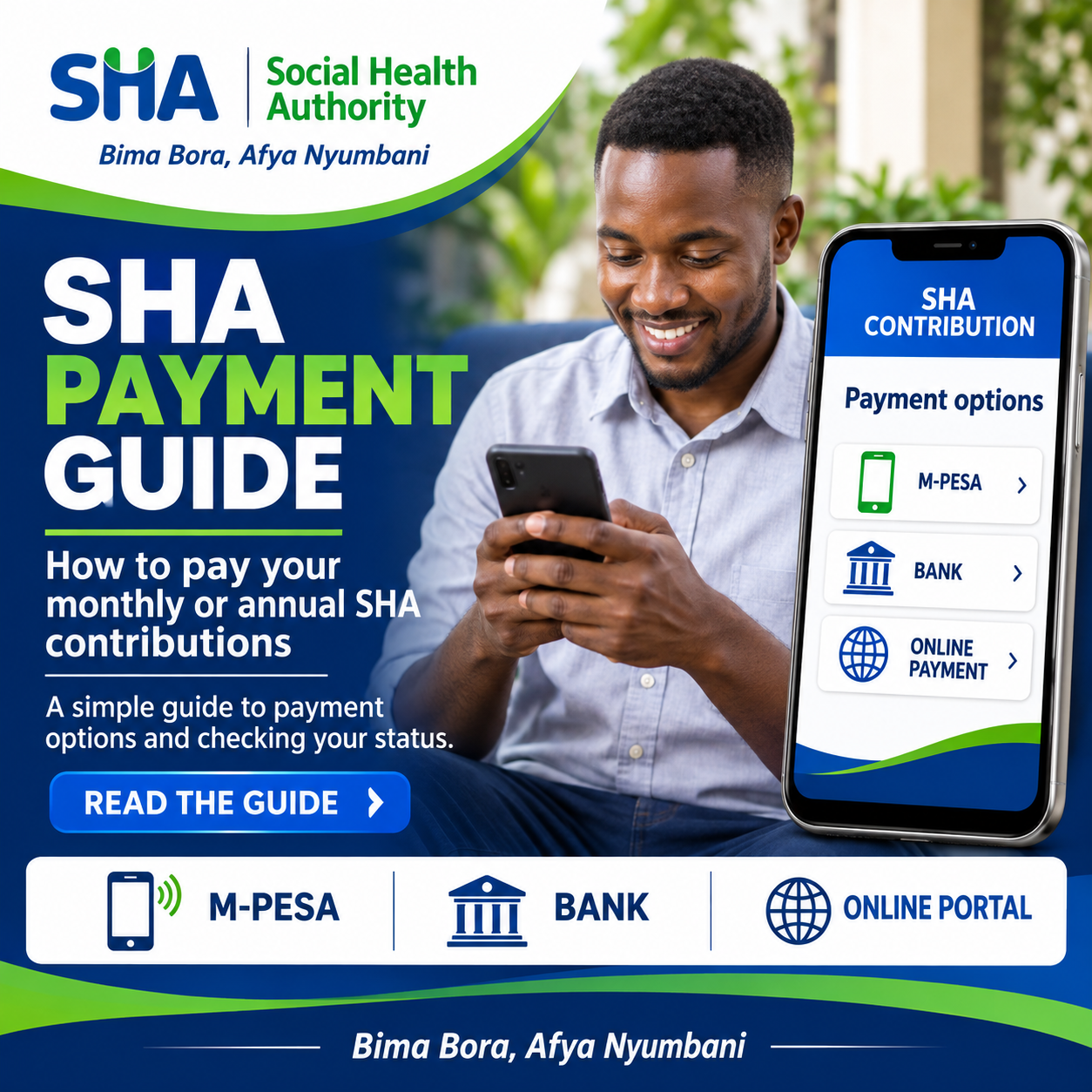
According to the notice, payments can be made through M-PESA Paybill 200222, with your national ID number as the account number.

Lipa Pole Pole: paying in instalments

If a full annual payment is hard to find at once, Lipa Pole Pole lets you spread it out.

SHA says the plan runs for two years, with the first four months' premium paid at the start and the remaining 20 months repaid daily, weekly or monthly.

It lists no interest or extra charges, and full annual cover begins on enrolment.

You can sign up in two ways.

For the first, you pay your four month upfront premium through M-PESA Paybill 200222 with your ID number as the account, then dial 147# and choose Lipa Pole Pole.

For the second, you dial 254#, go to Hustler Fund, then Lipa Pole Pole, select SHA Payment, choose a daily, weekly or monthly plan and set up M-PESA Ratiba for automatic deductions.

You qualify if you are a non salaried Kenyan resident, registered with SHA, have completed means testing and received your annual premium, and have no pending SHA arrears.

A Hustler Fund or Bridge loan does not stop you qualifying unless it is more than 45 days overdue.

Failing to repay may affect your eligibility for future digital financial services.

What if you cannot afford it?

Not everyone can pay, and SHA has a route for that.

Jacqueline Ngonyo, SHA's Senior Officer for Registration and Compliance, said on 26 October 2026 that people who cannot manage even the instalments are categorised and supported by the government as indigents.

The regulations say the means test is also how households needing financial help are identified, and that the national or county government then pays their contribution.

What happens if you pay late?

Late payment carries a penalty of 2% of the outstanding amount for the period it remains unpaid, set by section 27(6) of the Social Health Insurance Act, 2023.

Under section 27(4), you can use healthcare services under the Act only while your contributions are up to date and active, and under section 27(7) you must pay all outstanding contributions and penalties before you resume access.

The regulations say SHA must tell you of any penalty and how to pay it, and they separately say every person is entitled to emergency treatment.

How to check that your payment went through

After you pay, you will want to know it reached your record.

SHA's Eligibility Check at eligibility.sha.go.ke shows your coverage status, and you can log in to the member portal through Afya Yangu.

A statement of account shows your contribution record.

The regulations say it lists your beneficiaries, the benefits paid and the balance, the status of your contributions and any penalties, and that SHA must provide it within seven days of your request.

SHA's Citizens' Service Delivery Charter, revised in 2026, promises member statements free of charge within 30 days, requested by email or in person with identity verification.

What your payments cover

Contributions feed the Social Health Insurance Fund, which pays for care at Level 4, 5 and 6 facilities.

Under the regulations, registered members use primary healthcare at Level 2, 3 and designated Level 4 facilities, and a referral to a Level 4, 5 or 6 facility depends on your contributions being in order.

The charter says primary healthcare is free at the point of care at an accredited facility for a member with valid identification, and that referral services are free at the point of care once a valid referral is approved.

Whichever group you belong to, paying on time keeps your cover open and your family's with it.

Portrait of Joseph Mmwa, health journalistJoseph MmwaHealth & Medical Journalist

Share this story

Never miss health news that matters

Create a free account to follow stories shaping health in Kenya, Africa and around the world.

Comments

Be the first to comment.

Related Stories

Newsletter

The MMWA Briefing

Stay ahead of the health news shaping Kenya, Africa and the world. Get the week's most important developments, research and public-health stories — explained clearly and delivered to your inbox.